Introduction
When planning home interiors, choosing the right plywood thickness is just as important as choosing the right plywood grade.
You may see 6mm, 9mm, 12mm, 16mm and 18mm plywood mentioned in an interior quotation and wonder:
Why are different thicknesses being used?
The answer is simple: different furniture components have different structural requirements.
A back panel doesn’t need the same thickness as a wardrobe carcass. A drawer bottom doesn’t need the same strength as a bed or heavy-duty storage unit.
So, let’s understand where different plywood thicknesses are generally used in home interiors.
Does Thicker Plywood Always Mean Better?
Not necessarily.
A thicker sheet can provide greater stiffness, but choosing a thicker board everywhere can also:
- Increase cost
- Increase furniture weight
- Affect hardware selection
- Reduce usable internal space
- Be unnecessary for low-load components
The correct approach is to select the thickness according to load, span, size, construction method and application.
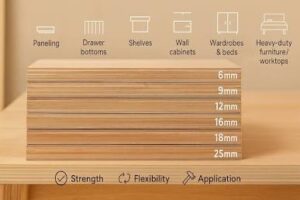
Plywood Thickness Guide at a Glance
| Thickness | Common Interior Applications |
|---|---|
| 6mm | Back panels, drawer bottoms, light-duty components |
| 9mm | Light partitions, selected cabinet components |
| 12mm | Shelves, partitions, smaller furniture components |
| 16mm | Modular furniture, selected carcass and shutter applications |
| 18mm | Main furniture structure, wardrobes, beds, cabinets |
These are general guidelines, not fixed rules. The final specification should always be based on the furniture design and expected load.
6mm Plywood: Where Should You Use It?
6mm plywood is generally used where the component does not need to carry significant structural load.
Common applications:
- Wardrobe back panels
- Cabinet backs
- Drawer bottoms
- Light partitions
- Selected decorative applications
Its main advantage is that it provides adequate support for lightweight components without unnecessarily adding weight or cost.
Avoid using 6mm plywood for:
- Heavy shelves
- Large structural panels
- Bed frames
- Main wardrobe carcasses
- Long unsupported spans
9mm Plywood: Where Should You Use It?
9mm sits between lightweight and structural applications.
It can be considered for:
- Light partitions
- Selected cabinet components
- Small storage units
- Decorative furniture components
- Applications where 6mm is insufficient but 12mm is unnecessary
However, its suitability depends heavily on the size and span of the component.
A 9mm panel may perform well in a small supported section but may not be appropriate for a large unsupported shelf.
12mm Plywood: Where Should You Use It?
12mm plywood offers a useful balance between weight, strength and cost.
It can be considered for:
- Shelves
- Internal partitions
- Small cabinets
- Selected drawer components
- Medium-duty furniture components
For shelving, remember that span matters.
A 12mm shelf supported at both ends may perform very differently from a long shelf with little or no intermediate support.
So simply saying “12mm is enough for all shelves” would be misleading.
16mm Plywood: Where Should You Use It?
16mm plywood is commonly considered for modular furniture where a balance between strength, weight and material efficiency is important.
Depending on the design, it can be used for:
- Selected wardrobe components
- Kitchen furniture
- Cabinets
- Partitions
- Shelves
- Selected shutters
It can be particularly useful in factory-made or modular furniture where precise construction and adequate support are incorporated into the design.
Whether 16mm or 18mm is better depends on the furniture’s dimensions, span, hardware and construction method.
18mm Plywood: Where Should You Use It?
18mm is one of the most commonly specified thicknesses for substantial home furniture.
It provides a stronger and stiffer panel than thinner boards and is commonly considered for:
- Wardrobe carcasses
- Kitchen cabinets
- Beds
- Large storage units
- Study tables
- TV units
- Heavy-duty furniture components
For large furniture pieces or components carrying substantial loads, 18mm can provide a useful combination of stiffness and durability.
But even 18mm plywood should not automatically be considered suitable for every application.
Design and support matter.
What Thickness Is Best for Wardrobes?
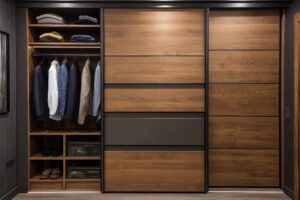
A wardrobe usually contains several different components, so using one thickness everywhere may not always be necessary.
Typical approach:
Main carcass:
16mm–18mm, depending on design and construction.
Shelves:
12mm–18mm depending on span and expected load.
Back panel:
6mm or another appropriate lightweight panel.
Shutters:
Thickness depends on shutter size, material, finish, hardware and construction.
For large shutters, stiffness and resistance to warping become particularly important.
The bigger the shutter, the more important proper construction becomes.
What Thickness Is Best for a Modular Kitchen?
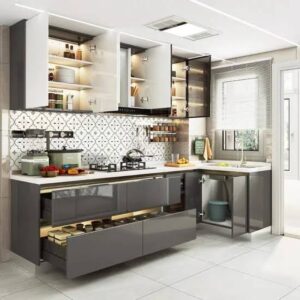
A modular kitchen also uses different components with different requirements.
Main cabinet structure
16mm–18mm can be considered depending on the system and construction.
Shelves
12mm–18mm depending on span and load.
Back panels
6mm or another suitable lightweight board can be considered.
Sink cabinet
Here, plywood grade and moisture resistance become especially important, not just thickness.
A thicker plywood sheet does not automatically make it more water-resistant.
For moisture-prone areas, select the appropriate plywood grade as well as the appropriate thickness.
What Thickness Is Best for a Bed?
A bed is a structural piece of furniture, so thickness should be selected based on the frame design, span, support system and expected load.
18mm plywood can be considered for many structural furniture components, but a professional design may use different thicknesses in different parts of the bed.
For larger spans or higher loads, the structural design may require additional support or a different material specification.
Thickness alone does not determine the strength of a bed.
16mm vs 18mm Plywood: Which Is Better?
This is a common question when homeowners compare interior quotations.
16mm
Advantages:
- Lighter
- Can reduce material usage
- Useful for modular furniture
- Can be sufficient for many applications when properly supported
18mm
Advantages:
- Greater panel stiffness
- Useful for larger structural components
- Suitable for heavier furniture applications
- Commonly used for substantial furniture bodies
So which should you choose?
Don’t simply choose 18mm because it is thicker.
If the furniture is properly designed and supported, 16mm may be sufficient for certain applications.
For larger, heavier or less-supported components, 18mm may provide a useful additional margin of stiffness.
The correct choice depends on the design.
Does Laminate Thickness Affect Plywood Selection?
Yes, it can.
When laminate, veneer or another finish is applied, the overall panel thickness increases.
This can also affect:
- Hinges
- Channels
- Edge profiles
- Shutter weight
- Furniture dimensions
- Hardware compatibility
This is particularly important for kitchen and wardrobe shutters.
Therefore, the plywood thickness should be considered as part of the complete furniture system, not in isolation.
Don’t Choose Plywood Thickness Only by Price
When reviewing an interior quotation, don’t simply ask:
“How much plywood are you using?”
Ask:
- What thickness is being used?
- Where is each thickness being used?
- What plywood grade is specified?
- What is the expected load?
- How are shelves supported?
- What thickness is used for the carcass?
- What thickness is used for shutters?
- What thickness is used for back panels?
A good interior quotation should make the material specification reasonably clear.
The Right Thickness Is About Design, Not Just Numbers
There is no universal rule that says:
“18mm is always best.”
Likewise, using thinner plywood everywhere simply to reduce cost is not a good approach.
The right thickness depends on:
Load + Span + Support + Furniture Type + Material Grade + Construction Quality
This is why professional furniture design considers the entire system rather than selecting plywood thickness in isolation.
Final Verdict
A simple way to remember the general application of plywood thickness is:
6mm → Lightweight & back panels
9mm → Light-duty components
12mm → Shelves & partitions
16mm → Selected modular furniture applications
18mm → Main structural furniture components
But these are guidelines, not universal rules.
The best interior is not one where the thickest plywood is used everywhere.
It is one where the right thickness, grade and construction method are selected for each application.
At Design Within, we believe a beautiful interior should not only look good when it is completed — it should also perform well for years.
Before we dive into more details about designing your furniture, it might be helpful to estimate how much your interior design project could cost. Understanding your budget can help you make more informed decisions about what features to prioritize. To get a better idea, you can use our ‘interior design budget calculator’ budget calculator and start planning your dream home today.
If you want to know more about best plywood for furniture then https://designwithin.in/best-plywood-for-furniture/
If you want to know more about mdf vs hdf vs hdhmr vs plywood then click https://designwithin.in/mdf-vs-hdf-vs-hdhmr-vs-plywood-which-is-best/
If you want to know more about bwr and bwp plywood then click https://designwithin.in/bwr-vs-bwp-plywood-which-is-best-for-kitchen-wardrobes/