Introduction
Plywood is one of the most important materials used in home interiors, but checking its quality is not always easy.
Two plywood sheets can look almost identical from the outside while having significant differences in their construction, grade and performance.
So, how can a homeowner check plywood quality before buying?
Here are 8 practical things you should check before approving plywood for your interiors.
1. Check the Plywood Grade
The first thing to check is the grade and intended application.
Plywood grades such as MR, BWR and BWP are designed for different moisture conditions.
For example:
MR → Generally suitable for relatively dry applications.
BWR → Suitable for applications requiring greater moisture resistance.
BWP → Intended for applications where higher moisture resistance is required.
For kitchens, wardrobes and other furniture, the grade should be selected according to the location and expected exposure.
Don’t simply accept the word “waterproof” without checking the actual product specification.
2. Check the Applicable Standard & Certification

A quality plywood product should have clearly identifiable product information.
Check:
- Applicable BIS standard
- ISI/BIS marking where applicable
- Manufacturer details
- Product grade
- Batch or identification details
- Thickness
For general-purpose plywood, the current BIS standard is IS 303:2024.
Don’t rely only on a brand name or verbal assurance from a contractor.
Ask to see the product details.
3. Look at the Plywood Edge
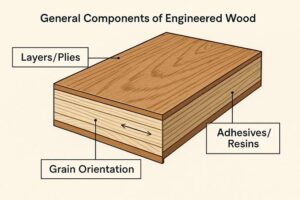
The edge of a plywood sheet can reveal a lot about its construction.
Look for:
- Consistent layers
- Proper bonding
- Minimal visible gaps
- No obvious delamination
- Uniform thickness
A poorly manufactured sheet may show excessive gaps, uneven layers or weak bonding along the edge.
A clean, consistent edge is generally a good sign of manufacturing quality.
4. Check the Thickness
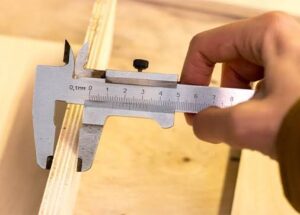
Don’t assume that a sheet labelled 18mm will always have exactly the same actual thickness as another manufacturer’s 18mm product.
Thickness should be checked with an appropriate measuring tool where necessary.
Why does this matter?
Because plywood thickness affects:
- Furniture dimensions
- Hardware installation
- Shutter alignment
- Edge finishing
- Structural performance
Also remember that thicker does not automatically mean better quality.
The correct thickness should be selected according to the furniture design and load requirements.
5. Check the Core for Gaps and Voids
Plywood is made from layers of veneer, so the quality of the internal core matters.
Look for:
- Large internal gaps
- Open voids
- Poorly joined veneer
- Uneven construction
- Excessive patches or defects
Large internal voids can reduce the consistency of the panel and may affect screw holding and long-term performance.
This is particularly important for furniture that requires reliable fastening.
6. Check for Warping
Place the plywood on a reasonably flat surface and inspect it from different angles.
Look for:
- Bending
- Twisting
- Bowing
- Uneven surfaces
A significantly warped sheet can create problems during furniture manufacturing and installation.
Some minor variation may occur depending on storage and environmental conditions, so the plywood should also be stored properly before installation.
7. Check the Manufacturer and Product Traceability
Plywood quality isn’t determined only by the word “BWP” or “18mm” printed on the sheet.
The manufacturer and product specification matter too.
Before purchasing, check:
- Manufacturer
- Product series
- Grade
- Standard
- Batch details
- Warranty, if offered
- Technical documentation
If your interior contractor is supplying the material, ask them to specify the exact plywood product and grade in the quotation.
This makes it easier to verify what has actually been supplied.
8. Check How the Plywood Will Be Used
This is perhaps the most overlooked point.
Even good-quality plywood can perform poorly if it is used incorrectly.
For example:
Kitchen sink area
Requires careful consideration of moisture resistance and edge protection.
Wardrobe
Needs appropriate thickness, support and construction.
Long shelf
Requires consideration of span and load.
Bed
Requires structural planning and proper joints.
So don’t ask only:
“Which plywood are you using?”
Also ask:
“Where are you using which plywood, and why?”
That question can tell you a lot about the quality of the interior specification.
Don’t Check Plywood Quality by Price Alone
A common mistake is assuming:
Higher price = better plywood.
Price can vary because of:
- Brand
- Grade
- Thickness
- Manufacturing process
- Certification
- Product specifications
- Warranty
- Market positioning
Instead of asking only for the cheapest quotation, compare the complete material specification.
Ask for:
Brand + Grade + Thickness + Standard + Application
Then compare quotations.
What About the “Tap Test”?
You may have heard that tapping plywood can help identify quality.
It can sometimes provide a basic indication of hollow areas or inconsistent construction, but it should not be treated as a reliable quality-control method on its own.
A proper evaluation should focus on the product’s specification, certification, construction, condition and intended application.
Quick Plywood Quality Checklist
Before accepting plywood for your home interiors, check:
☑ Grade
☑ Applicable BIS standard
☑ Certification/marking where applicable
☑ Manufacturer
☑ Thickness
☑ Edge construction
☑ Core quality
☑ Voids and gaps
☑ Warping
☑ Product traceability
☑ Correct application
Keep this checklist handy when reviewing your interior material.
Final Verdict
Good plywood is not simply about choosing the thickest or most expensive sheet.
Quality comes from a combination of:
Correct grade + Good manufacturing + Appropriate thickness + Proper application + Good workmanship
A reliable interior designer should be able to explain what plywood is being used, where it is being used and why that specification has been selected.
At Design Within, we believe homeowners should understand what goes behind their interiors — not just what they see on the surface.
Because a beautiful finish may catch your eye, but good material selection and construction are what help an interior perform well for years.
At Design Within, we believe a beautiful interior should not only look good when it is completed — it should also perform well for years.
Before we dive into more details about designing your furniture, it might be helpful to estimate how much your interior design project could cost. Understanding your budget can help you make more informed decisions about what features to prioritize. To get a better idea, you can use our ‘interior design budget calculator’ budget calculator and start planning your dream home today.
If you want to know more about best plywood for furniture then https://designwithin.in/best-plywood-for-furniture/