Introduction
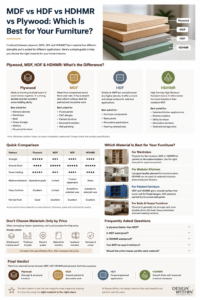
When planning your home interiors, you may hear terms like plywood, MDF, HDF and HDHMR from your interior designer or contractor.
But which one is actually better?
The answer is simple: there is no single material that is best for every application.
The right choice depends on where the furniture will be used, moisture exposure, strength requirements, finish and budget.
Let’s understand the difference in simple terms.
Plywood, MDF, HDF & HDHMR: What’s the Difference?
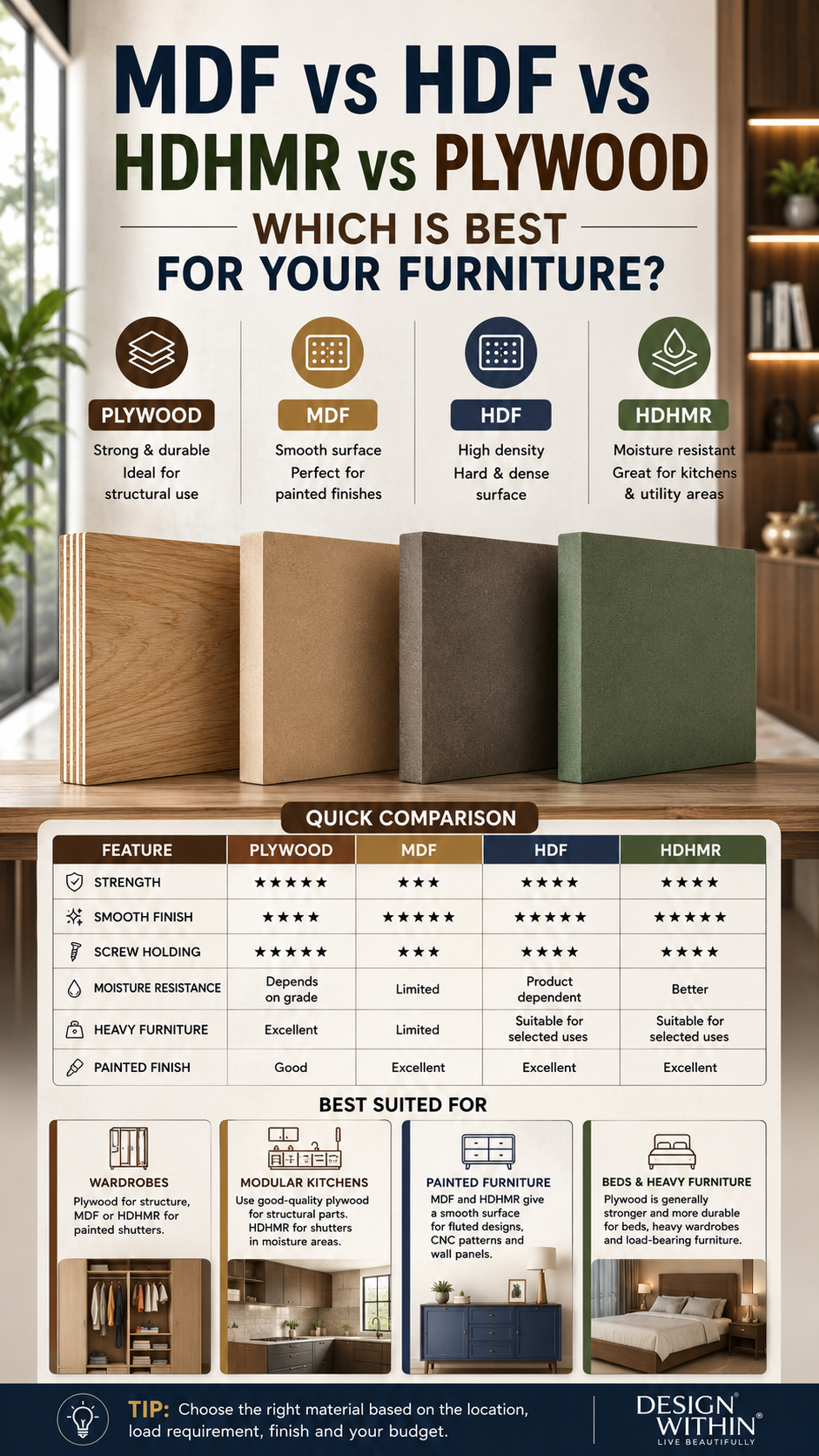
Plywood
Plywood is made by bonding multiple layers of wood veneer together. It is known for its strength, durability and good screw-holding ability.
Best suited for:
- Kitchen cabinets
- Wardrobes
- Beds
- Heavy storage
- Shelves
- Structural furniture
For moisture-prone areas, the correct plywood grade should always be selected.
MDF
MDF or Medium Density Fibreboard is made from compressed wood fibres and resin.
Its biggest advantage is its smooth and uniform surface, making it excellent for painted and decorative furniture.
Best suited for:
- Fluted panels
- CNC designs
- Painted furniture
- Decorative shutters
- Wall panelling
Standard MDF should not be treated as waterproof.
HDF
HDF or High Density Fibreboard is similar to MDF but manufactured at a higher density.
It provides a hard and dense surface and can be used for selected furniture and decorative applications.
However, higher density does not automatically make it better than plywood for structural furniture.
HDHMR
HDHMR stands for High Density High Moisture Resistant board.
It is designed to offer better moisture resistance than standard MDF, along with a smooth surface suitable for various finishes.
Can be considered for:
- Selected kitchen applications
- Kitchen shutters
- Utility furniture
- Decorative furniture
- Selected storage units
Remember: moisture-resistant does not mean completely waterproof.
Which Is Best for Wardrobes?
For wardrobe structural components, good-quality plywood is generally a reliable option.
MDF or HDHMR can be considered for painted or decorative shutters, depending on the design and application.
So you don’t necessarily have to use one material throughout the wardrobe.
Structure → focus on strength.
Shutters & decoration → focus on finish and application.
Which Is Best for a Modular Kitchen?
Kitchen furniture needs special attention because it is exposed to:
- Water
- Steam
- Heat
- Oil
- Humidity
- Frequent cleaning
For structural kitchen components, appropriately graded plywood is a commonly preferred option.
HDHMR can also be considered for selected applications where moisture resistance and a smooth surface are required.
The important thing is to select the right material for each component, rather than assuming one material is best for the entire kitchen.
Which Is Best for Painted Furniture?
If you want a smooth painted finish, MDF and HDHMR can be excellent choices.
They work particularly well for:
- Fluted designs
- CNC patterns
- Decorative panels
- Painted shutters
- Wall mouldings
But remember, the final finish also depends on surface preparation, primer, paint quality and workmanship.
Plywood vs MDF: Which One Should You Choose?
A simple way to decide:
Choose Plywood when:
You need strength, durability and good screw holding.
Choose MDF when:
You want a smooth surface, painted finish or detailed CNC work.
Choose HDF when:
You need a denser engineered board for a suitable application.
Choose HDHMR when:
You want a smooth board with improved moisture resistance for appropriate applications.
Plywood vs MDF: Which Is Better for Wardrobes?
Both can have a role in wardrobes.
Plywood
Plywood is generally a strong option for the structural components of a wardrobe.
It can be particularly useful for:
- Carcass construction
- Shelves
- Heavy-duty storage
- Structural partitions
MDF
MDF can be useful for:
- Painted shutters
- Decorative panels
- CNC designs
- Fluted designs
- Selected lightweight components
HDHMR
HDHMR can be considered where you want:
- A smooth surface
- Decorative finishing
- Improved moisture resistance
- A board suitable for selected wardrobe components
Our practical approach
Rather than insisting on one material throughout the wardrobe, select the material according to the function of each component.
Structure and load → focus on strength.
Decorative finish → focus on surface quality.
This approach can give you a better combination of performance and appearance.
Don’t Choose Materials Only by Price
When comparing interior quotations, don’t simply compare the final amount.
Ask:
- Which board is being used?
- What thickness?
- What plywood grade?
- Which brand?
- What material is being used for shutters?
- Which hardware is included?
- What finish is included?
Two interior quotations may look similar but have very different material specifications.
Always compare the specification before comparing the price.
Final Verdict
There is no universal winner between MDF vs HDF vs HDHMR vs plywood.
Each material has its own purpose.
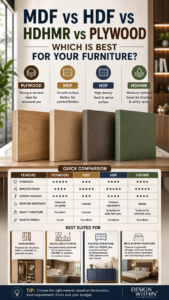
Plywood → Strength & structural furniture
MDF → Smooth painted & decorative work
HDF → Dense engineered applications
HDHMR → Smooth finish with improved moisture resistance
The best interior isn’t necessarily the one using the most expensive material.
It is the one using the right material in the right place.
At Design Within, we believe a beautiful interior should not only look good when it is completed — it should also perform well for years.
Before we dive into more details about designing your furniture, it might be helpful to estimate how much your interior design project could cost. Understanding your budget can help you make more informed decisions about what features to prioritize. To get a better idea, you can use our ‘interior design budget calculator’ budget calculator and start planning your dream home today.
If you want to know more about best plywood for furniture then https://designwithin.in/best-plywood-for-furniture/