Introduction :
When choosing flooring for a 2BHK, 3BHK & 4BHK new home or renovation or for a new Villa, two options often come up: vitrified tiles and natural marble.
Both can create beautiful, durable floors, but they are fundamentally different materials.
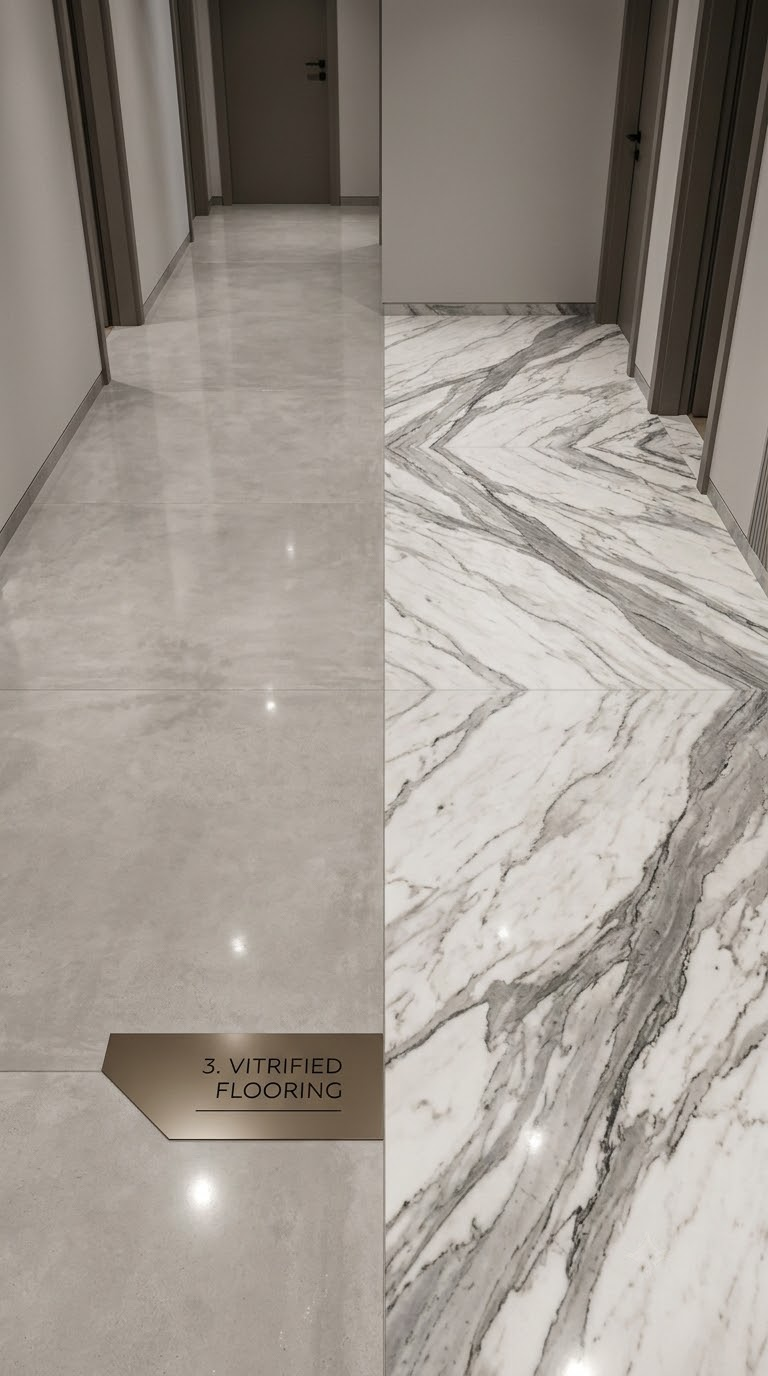
Vitrified tiles offer consistency, design flexibility and relatively easy maintenance. Marble offers natural variation, distinctive veining and a luxurious character that manufactured tiles cannot completely reproduce.
So, which one should you choose?
The answer depends on your budget, lifestyle, maintenance expectations, room size and design preference.
Vitrified Tiles vs Marble: At a Glance
| Factor | Vitrified Tiles | Marble |
|---|---|---|
| Material | Manufactured | Natural stone |
| Appearance | Consistent | Unique natural variation |
| Design options | Very wide | Depends on stone |
| Maintenance | Generally low | Medium to high |
| Water absorption | Very low | Varies; requires care |
| Staining | Generally resistant | Can stain |
| Scratches | Good resistance depending on product | Can scratch |
| Repairs | Individual tile replacement | Can often be polished |
| Installation | Relatively straightforward | More specialised |
| Cost | Wide range | Wide range, often higher for premium varieties |
| Luxury appeal | High | Very high |
| Uniformity | High | Low |
Neither option is universally better.
1. Appearance and Design
Vitrified Tiles
One of the biggest advantages of vitrified tiles is design flexibility.
Modern tiles can reproduce the appearance of:
- Marble
- Natural stone
- Concrete
- Wood
- Terrazzo
- Other decorative surfaces
They are also available in different colours, patterns, sizes and finishes.
Marble
Marble has a different kind of appeal.
Its veining is naturally formed, and each slab can have variations in colour and pattern. This makes the finished floor more individual.
Winner for natural character: Marble
Winner for design variety and consistency: Vitrified tiles
2. Maintenance
This is one of the biggest practical differences.
Vitrified tiles are generally easy to clean and maintain. Routine sweeping and mopping are usually sufficient for residential use.
Marble requires more attention. Depending on the variety and application, it may require sealing, careful cleaning and periodic polishing.
Marble can also be more sensitive to staining and acidic substances.
Winner for low maintenance: Vitrified tiles
3. Durability
Both materials can last for many years when properly selected and installed.
Vitrified tiles are dense and designed for residential wear. However, performance varies between products.
Marble is also durable, but being a natural stone, it can develop scratches, stains and surface wear over time.
One advantage of marble is that it can often be professionally polished and restored.
Winner: It depends on the application and product quality.
4. Water and Moisture
Vitrified tiles generally have very low water absorption, making them suitable for many areas of a home.
Marble is more porous and needs appropriate care and sealing depending on the stone.
For bathrooms and other wet areas, the decision should also consider slip resistance and surface finish, not simply water absorption.
Winner for easier moisture management: Vitrified tiles
5. Cost
This is where comparisons can become misleading.
There is no single price for either material.
Basic vitrified tiles can be relatively affordable, while premium large-format tiles can be expensive.
Similarly, Indian marble can range from moderately priced to very expensive, while premium imported marble can cost substantially more.
The actual project cost also includes:
- Wastage
- Labour
- Adhesive or bedding material
- Transportation
- Skirting
- Surface preparation
- Polishing
- Sealing where required
So don’t compare a ₹100/sq. ft. marble slab with a ₹100/sq. ft. tile and assume the final installed cost will be identical.
Winner for budget flexibility: Vitrified tiles
6. Installation
Vitrified tiles are generally easier to handle and install than large natural-stone slabs.
Marble installation requires careful slab selection, layout planning, levelling, joint treatment and polishing.
With marble, the direction of the veining and placement of individual slabs can have a major impact on the final appearance.
Winner for simpler installation: Vitrified tiles
7. Repairs and Replacement
If a vitrified tile becomes badly damaged, the usual solution is to replace that tile.
The challenge is that replacement tiles from a different batch may not exactly match the original shade.
Marble has a different advantage: minor surface wear can often be addressed through professional polishing.
However, replacing a damaged marble section can be more complicated because of natural variation between slabs.
Winner: Neither universally. The repair method is simply different.
8. Comfort and Feel
Both materials are hard surfaces.
Marble and vitrified tiles can also feel cool underfoot, particularly in cooler weather.
If warmth and a softer feel are priorities, materials such as wood, engineered wood, laminate or SPC may be worth considering.
This is an important point: if your main requirement is comfort, the real comparison may not be marble versus vitrified tiles at all.
Which Is Better for Different Rooms?
| Room | Better Option to Consider | Why |
|---|---|---|
| Living Room | Both | Depends on design & budget |
| Dining Room | Both | Both can work well |
| Bedroom | Vitrified / Marble / alternatives | Personal comfort preference |
| Kitchen | Vitrified | Easy maintenance |
| Bathroom | Suitable anti-skid tiles | Safety is important |
| Entrance | Marble / Vitrified | Both offer strong visual impact |
| Passage | Vitrified / Marble | Both can handle residential traffic |
| Balcony | Suitable outdoor tiles | Weather and slip resistance matter |
When Should You Choose Vitrified Tiles?
Vitrified tiles may be the better choice if you want:
- Low maintenance
- Consistent appearance
- A large range of designs
- Marble or stone-look flooring
- Large-format options
- Easier replacement
- Greater flexibility across different budgets
They are particularly practical for homeowners who want a beautiful floor without a high maintenance commitment.
When Should You Choose Marble?
Marble may be the better choice if you want:
- Natural stone
- Unique veining
- A luxury appearance
- A statement floor
- Natural variation
- The ability to polish and restore the surface
Marble is particularly effective in large living rooms, entrances and luxury residences where the flooring itself is an important design element.
Common Mistakes When Comparing Marble and Vitrified Tiles
Comparing only the price per sq. ft.
The final installed cost can be very different from the material price.
Choosing marble only because it looks luxurious
Natural stone requires more maintenance than many homeowners expect.
Choosing vitrified tiles only because they are practical
Design is still important. A poor tile selection can make an otherwise well-designed interior look ordinary.
Ignoring the overall interior
Flooring should complement furniture, walls, doors, lighting and cabinetry.
Forgetting installation quality
A premium material cannot compensate for poor installation.
So, Which Is Better?
There is no universal winner.
Choose vitrified tiles if your priorities are:
Low maintenance + design flexibility + predictable appearance + budget control
Choose marble if your priorities are:
Natural beauty + unique character + luxury + statement interiors
And if you are still unsure, consider using both.
For example, a home could use marble in the entrance and living area, while bedrooms and other spaces use vitrified tiles or another suitable flooring material.
The best flooring strategy does not necessarily mean selecting one material for the entire home.
Final Thoughts
Vitrified tiles and marble can both create beautiful interiors, but they solve different problems.
Vitrified tiles are about practicality, consistency and flexibility. Marble is about natural character, luxury and individuality.
The right choice depends on how you live, how much maintenance you are comfortable with, your budget and the design you want to achieve.
At Design Within, flooring is selected as part of the complete interior scheme rather than in isolation. The floor needs to work with the furniture, lighting, wall finishes and lifestyle of the family.
Don’t ask which flooring is universally better. Ask which flooring is better for your home.
At Design Within, we believe a beautiful interior should not only look good when it is completed — it should also perform well for years.
Before we dive into more details about designing your furniture, it might be helpful to estimate how much your interior design project could cost. Understanding your budget can help you make more informed decisions about what features to prioritize. To get a better idea, you can use our ‘interior design budget calculator’ budget calculator and start planning your dream home today.
Frequently Asked Questions
Is vitrified tile better than marble?
Not universally. Vitrified tiles are generally easier to maintain and offer greater consistency, while marble provides natural variation and a more distinctive luxury appearance.
Is marble more expensive than vitrified tiles?
Premium marble can be considerably more expensive, but both categories have wide price ranges. The actual material, quality, size, installation and finishing should be compared.
Which is easier to maintain?
Vitrified tiles are generally easier to maintain than marble.
Which lasts longer, marble or vitrified tiles?
Both can last for many years when properly selected and installed. Actual lifespan depends on material quality, installation, usage and maintenance.
Can vitrified tiles look like marble?
Yes. Modern GVT and PGVT tiles can reproduce marble-inspired patterns and veining with a high degree of visual similarity.
Is marble good for Indian homes?
Yes. Marble can work very well in Indian homes, particularly in living rooms, entrances and luxury interiors, provided homeowners are comfortable with its maintenance requirements.