Introduction
Gypsum vs POP vs PVC False Ceiling: Which Is Best for Your Home?
Choosing a false ceiling is not simply about selecting the cheapest material.
The right ceiling should complement your interior design, ceiling height, lighting, maintenance requirements and the specific room where it will be installed.
Among the most commonly considered options are gypsum, POP and PVC false ceilings. However, modern interiors also use combinations such as gypsum with plywood, plywood with veneer or laminate, and gypsum finished with wallpaper.
So, which false ceiling is best for your home?
The answer depends on what you want the ceiling to achieve.
In this guide, we compare the major options to help you make a practical decision.
Gypsum vs POP vs PVC: Quick Comparison
| Feature | Gypsum | POP | PVC |
|---|---|---|---|
| Modern finish | Excellent | Excellent | Good |
| Design flexibility | High | Very High | Moderate |
| Curved designs | Good | Excellent | Limited |
| Lighting integration | Excellent | Excellent | Good |
| Moisture resistance | Depends on board/system | Lower | Good |
| Maintenance | Low | Moderate | Low |
| Premium appearance | Excellent | Excellent | Moderate |
| Installation | Relatively quick | More site-dependent | Quick |
| Best suited for | Modern interiors | Decorative designs | Utility/moisture-prone areas |
There is no universal winner. Each material has its strengths.
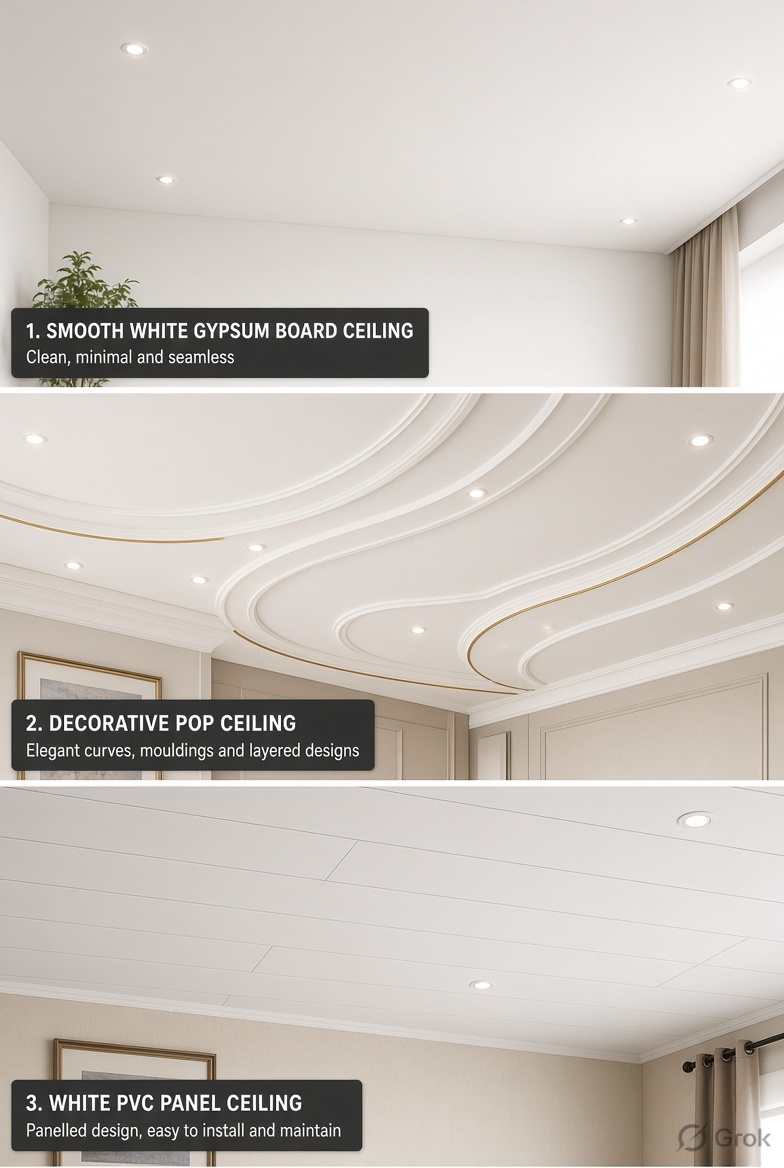
1. Gypsum False Ceiling

Gypsum is one of the most popular choices for modern residential interiors.
Gypsum boards provide a smooth, clean surface and work particularly well with contemporary lighting and minimal ceiling designs.
Advantages of gypsum
-
Clean and seamless appearance
-
Excellent for modern interiors
-
Works well with recessed lights and profile lights
-
Suitable for cove lighting
-
Can create single-level and multi-level designs
-
Relatively quick installation
-
Easy to integrate with electrical and other services
Gypsum is particularly suitable for:
-
Living rooms
-
Bedrooms
-
Dining areas
-
Passages
-
Home offices
For most contemporary homes, gypsum is often the most versatile all-round option.
2. POP False Ceiling

POP, or Plaster of Paris, has been used extensively for decorative residential ceilings.
Its biggest advantage is its ability to be shaped into customised forms.
POP is particularly useful for:
-
Curved designs
-
Decorative mouldings
-
Cornices
-
Circular details
-
Ornamental designs
-
Custom profiles
Advantages of POP
-
Excellent design flexibility
-
Suitable for intricate detailing
-
Can create customised curves and shapes
-
Smooth finished appearance
-
Works well with decorative ceiling designs
However, POP work is highly dependent on craftsmanship and site execution.
For a simple modern ceiling, gypsum may be more practical. For a highly customised decorative ceiling, POP can offer greater freedom.
3. PVC False Ceiling

PVC false ceilings are generally chosen for practicality rather than elaborate architectural detailing.
PVC panels are moisture-resistant and relatively easy to maintain.
They can be considered for:
-
Balconies
-
Utility areas
-
Kitchens
-
Certain moisture-prone spaces
Advantages of PVC
-
Good moisture resistance
-
Easy maintenance
-
Lightweight
-
Available in different colours and patterns
-
Relatively economical
-
Quick installation
However, PVC generally offers less design flexibility than gypsum or POP.
For premium living rooms and bedrooms, gypsum or a combination of gypsum and wood-finished elements may provide a more sophisticated result.
Gypsum vs POP: Which Is Better?
This is one of the most common questions homeowners ask.
Choose gypsum if:
You want a clean, modern and minimal ceiling with integrated lighting.
Choose POP if:
You want curves, decorative details, mouldings or highly customised shapes.
In other words:
Gypsum = modern and versatile
POP = decorative and highly flexible
Neither is automatically better.
The design requirement should determine the material.
Gypsum vs PVC: Which Is Better?
Gypsum generally provides a more architectural and premium appearance, while PVC has an advantage in areas where moisture resistance and easy maintenance are important.
Choose gypsum for:
-
Living rooms
-
Bedrooms
-
Dining rooms
-
Modern interiors
-
Integrated lighting
Consider PVC for:
-
Balconies
-
Utility areas
-
Moisture-prone applications
-
Areas where easy cleaning is important
The room’s conditions should be considered before selecting the material.
POP vs PVC: Which Is Better?
These materials serve very different purposes.
POP is primarily chosen for design flexibility and decorative detailing.
PVC is generally chosen for practicality, moisture resistance and easy maintenance.
Therefore:
For decorative design → POP
For practical moisture-resistant applications → PVC
What About Plywood, Veneer and Laminate Ceilings?
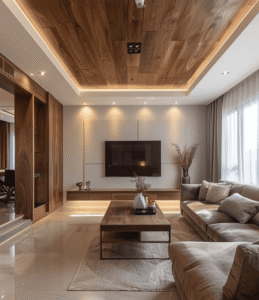
A false ceiling does not have to be made entirely from gypsum, POP or PVC.
In premium residential interiors, plywood can be used as a ceiling substrate and finished with natural veneer or laminate.
Plywood + Veneer
This creates a genuine wood appearance and works particularly well for:
-
Luxury living rooms
-
Dining areas
-
Bedrooms
-
Feature ceilings
Plywood + Laminate
Laminate provides a wide range of colours, textures and wood-look finishes and can be used to create a more contemporary feature ceiling.
These options are generally more expensive than a basic gypsum ceiling, but they can create a strong architectural feature.
Can Gypsum and Plywood Be Used Together?
Yes—and this can be one of the most effective solutions for a premium interior.
For example:
Main ceiling → Gypsum + paint
Feature section → Plywood + veneer
Lighting → Cove / profile / recessed lighting
This allows you to introduce a premium wood element without making the entire ceiling expensive.
The same principle can be applied using laminate.
Can Wallpaper Be Used on a False Ceiling?
Yes.
A properly prepared gypsum ceiling can be finished with wallpaper instead of conventional paint.
This can create an interesting feature in:
-
Bedrooms
-
Luxury interiors
-
Kids’ rooms
-
Feature spaces
However, the gypsum surface must be properly finished before wallpaper is installed. Any uneven joints or surface imperfections can become visible through the wallpaper.
Which False Ceiling Is Best for Each Room?
| Room | Recommended Options |
|---|---|
| Living Room | Gypsum, POP, Gypsum + Plywood/Veneer |
| Master Bedroom | Gypsum, Gypsum + Wallpaper, Gypsum + Veneer |
| Kids’ Bedroom | Gypsum, Gypsum + Wallpaper |
| Dining Area | Gypsum, POP, Gypsum + Veneer |
| Passage | Gypsum |
| Home Office | Gypsum, Gypsum + Veneer |
| Balcony | PVC or suitable exterior/moisture-resistant system |
| Utility Area | PVC or suitable moisture-resistant system |
These are general recommendations. The final selection should depend on the specific site conditions and overall interior design.
Which False Ceiling Is the Most Cost-Effective?
The cheapest option is not necessarily the most cost-effective.
A low initial price may become less attractive if the material is unsuitable for the room or does not achieve the desired finish.
A better way to think about value is:
Material cost + installation + finishing + maintenance + design life + suitability
For example, spending more on a plywood-and-veneer feature in the living room may make sense if it becomes a major design element, while using an expensive material in a utility area may not.
What About False Ceiling Cost?
The cost varies significantly depending on the material and specification.
As a broad planning guide for Pune:
-
POP: generally lower to mid-range
-
Gypsum: mid-range
-
PVC: lower to mid-range
-
Gypsum + plywood: mid to premium
-
Plywood + laminate: premium
-
Plywood + veneer: premium
-
Gypsum + wallpaper: depends on the wallpaper and ceiling specification
For current Pune pricing and room-wise budgeting, see our detailed guide:
False Ceiling Cost in Pune 2026: Complete Price Guide Per Sq. Ft.
The important point is to compare complete specifications, rather than choosing a contractor based only on the quoted rate per square foot.
Which False Ceiling Should You Choose?
If you want a quick decision:
🏆 Best all-rounder: Gypsum
For most modern homes, gypsum offers an excellent balance of appearance, versatility, lighting integration and practicality.
🎨 Best for decorative designs: POP
Choose POP when curves, mouldings or intricate customised details are central to the design.
💧 Best for practical moisture-prone areas: PVC
PVC can be considered where moisture resistance and easy maintenance are more important than a highly architectural appearance.
🌳 Best for a premium wood look: Plywood + Veneer
Choose plywood with natural veneer when you want warmth, natural grain and a luxury wood finish.
✨ Best for a contemporary feature: Gypsum + Plywood
Combining gypsum with plywood allows you to create contrast and premium feature elements without using wood across the entire ceiling.
🖼️ Best for a decorative surface: Gypsum + Wallpaper
Wallpaper can transform a simple gypsum ceiling into a distinctive feature element.
The Best False Ceiling Is Not Always the Most Expensive
A well-designed ceiling is about proportion and coordination, not simply adding more materials.
A simple gypsum ceiling with well-planned lighting can look more elegant than an unnecessarily complicated multi-level ceiling.
Similarly, a small veneer feature can sometimes create more impact than covering an entire room in expensive wood.
The ceiling should work together with the:
-
Furniture
-
Lighting
-
Walls
-
Flooring
-
AC and other services
-
Overall colour palette
-
Architectural character of the room
This is why false ceiling design should ideally be planned as part of the complete interior design.
How Design Within Approaches False Ceiling Design
At Design Within, we don’t treat the false ceiling as an isolated construction item.
The ceiling is planned along with the overall interior so that the design, lighting, materials and proportions work together.
Depending on the project, this can mean using:
Gypsum + paint
or
Gypsum + plywood + veneer
or
Gypsum + laminate
or
Gypsum + wallpaper
or a combination of several materials.
The objective is not to use the most expensive material.
The objective is to use the right material in the right place.
Final Verdict: Gypsum vs POP vs PVC
So, which is the best false ceiling for your home?
There is no single answer.
Choose gypsum for a versatile modern ceiling.
Choose POP for decorative and highly customised designs.
Choose PVC for practical applications where moisture resistance and easy maintenance are important.
Choose plywood + veneer when you want a premium natural-wood feature.
Choose plywood + laminate for a wide range of decorative finishes.
Combine gypsum and plywood when you want a sophisticated mix of painted and wood-finished surfaces.
Consider wallpaper over gypsum when you want the ceiling itself to become a decorative feature.
Ultimately, the best false ceiling is the one that suits your room, ceiling height, design style, lighting requirements, maintenance needs and budget.
If you are planning a home interior in Pune, Design Within can help you select the right ceiling system and coordinate it with your complete interior design.
At Design Within, we believe a beautiful interior should not only look good when it is completed — it should also perform well for years.
Before we dive into more details about designing your furniture, it might be helpful to estimate how much your interior design project could cost. Understanding your budget can help you make more informed decisions about what features to prioritize. To get a better idea, you can use our ‘interior design budget calculator’ budget calculator and start planning your dream home today.
Frequently Asked Questions
Which is better, gypsum or POP false ceiling?
Gypsum is generally better suited to clean, modern ceiling designs and integrated lighting, while POP offers greater flexibility for decorative curves, mouldings and intricate details.
Which false ceiling is best for a living room?
Gypsum is an excellent all-round choice for a modern living room. For a more premium design, gypsum can be combined with plywood finished with veneer or laminate.
Which false ceiling is best for a bedroom?
Gypsum is a popular choice for bedrooms because it provides a clean appearance and works well with soft cove and recessed lighting. Gypsum with wallpaper or a veneer feature can also be considered.
Is PVC better than gypsum?
Not necessarily. PVC can be more suitable for moisture-prone and utility areas, while gypsum generally offers greater design flexibility and a more premium architectural appearance.
Can plywood be used for a false ceiling?
Yes. Plywood can be used as a ceiling substrate and finished with veneer or laminate to create premium wood-finished ceiling designs.
Can gypsum and plywood be combined?
Yes. A combination of gypsum and plywood is commonly used to create contrasting ceiling levels and feature elements.
Can wallpaper be applied to a gypsum ceiling?
Yes. Wallpaper can be applied to a properly prepared gypsum surface, provided the joints and finishing are done correctly.
Which false ceiling lasts the longest?
The lifespan depends not only on the material but also on the quality of the framework, installation, finishing, environmental conditions and maintenance.
Is POP cheaper than gypsum?
It can be, particularly for certain designs, but the final cost depends on design complexity, workmanship and the complete scope of work.
What is the most modern false ceiling?
There is no single modern material. Contemporary interiors commonly use clean gypsum ceilings, linear/profile lighting and selective combinations of gypsum with plywood, veneer, laminate or other feature finishes.