Introduction
Planning your home interiors is exciting, but managing the budget can quickly become complicated. Material choices, furniture, lighting, electrical work, civil work, hardware, labour and design fees can all affect the final cost.
A common mistake homeowners make is starting the design process without deciding how much they are actually comfortable spending. The result is often budget overruns, compromises at the end of the project, or unexpected expenses.
A well-planned interior budget does not mean choosing the cheapest materials. It means deciding where to spend, where to save, and how to control costs before the work begins.
This guide explains how to plan and manage your interior design budget in India.
Why Interior Design Budgets Go Over Budget
Interior costs rarely increase because of one major decision. Small changes throughout the project can add up quickly.
Common reasons include:
-
Changing the design after work has started
-
Selecting premium materials at the last minute
-
Underestimating electrical and plumbing requirements
-
Adding furniture or storage later
-
Not accounting for hardware and accessories
-
Unclear scope of work
-
Comparing quotes only on the final price
-
Unexpected civil or site-related work
The best way to avoid these problems is to establish the project scope and budget before finalizing the design.
Step 1: Decide Your Overall Interior Budget
What Affects Interior Design Cost in India?
Then briefly cover:
- Home size
- 2BHK vs 3BHK vs 4BHK
- Number of wardrobes
- Kitchen size
- Material specifications
- Hardware quality
- Furniture requirements
- Civil modifications
- Electrical requirements
- Design complexity
- Turnkey vs individual contractors
Start with the total amount you are comfortable investing in the project.
Do not begin by asking, “How much will my interiors cost?”
Instead, ask:
“What is my maximum comfortable budget, and what do I want to achieve within it?”
Your budget should consider:
-
Size and type of home
-
Number of rooms
-
Amount of storage required
-
Kitchen requirements
-
Furniture requirements
-
Material quality
-
Electrical and lighting work
-
Civil modifications
-
Design fees
-
Appliances and accessories
-
Contingency for unexpected expenses
For a 2BHK, 3BHK or 4BHK, the budget can vary significantly depending on the scope and specifications. There is no single per-square-foot figure that accurately represents every interior project.
Planning your interior budget? Use our Interior Design Budget Calculator to get an initial estimate before finalizing your design requirements.
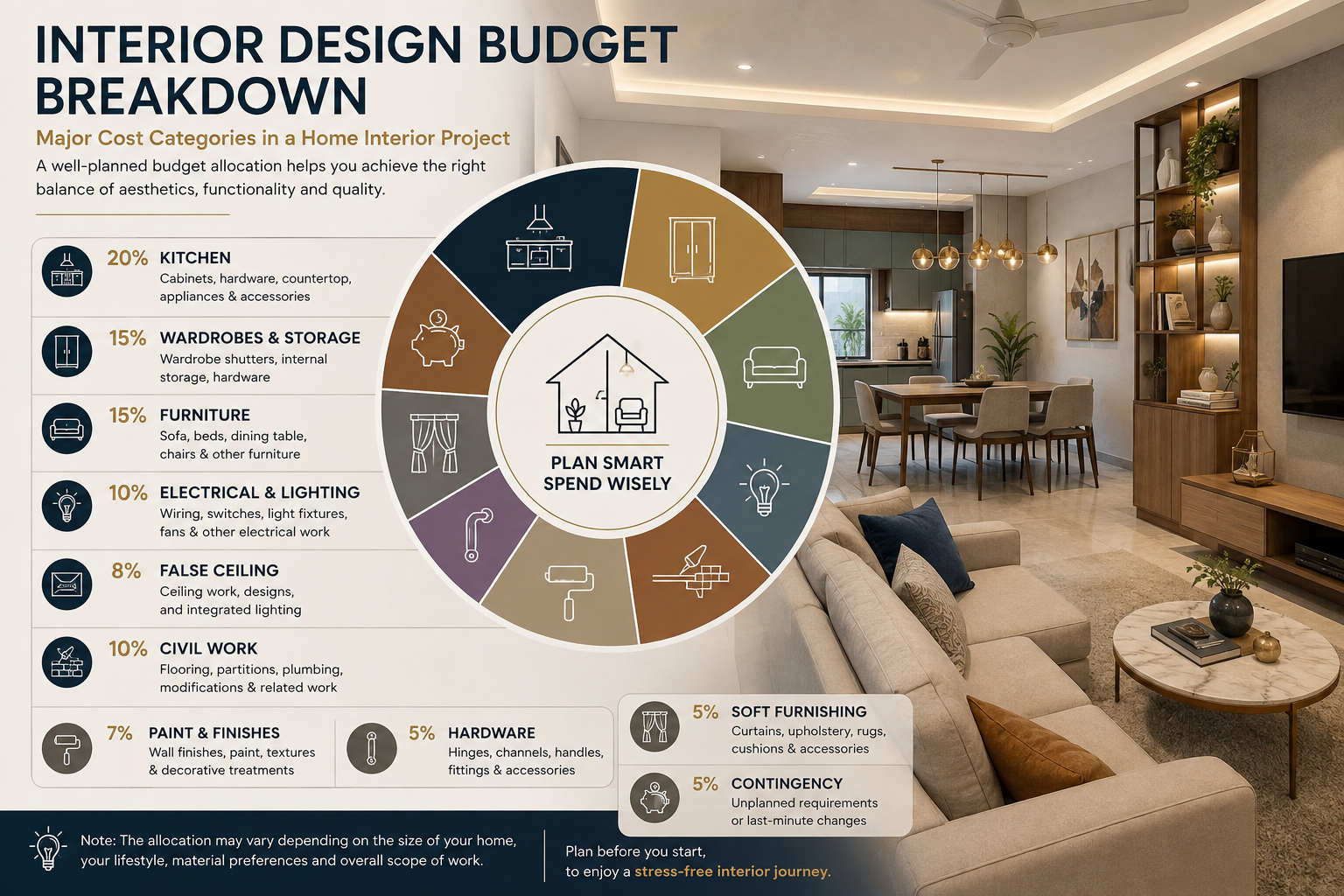
Step 2: Divide the Budget Into Categories
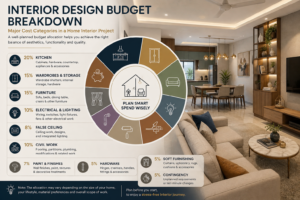
Instead of treating your budget as one large number, divide it into major categories.
A typical home interior budget may include:
| Category | What It Includes |
|---|---|
| Design | Planning, drawings, 3D views and detailing |
| Kitchen | Cabinets, hardware, countertop and accessories |
| Wardrobes | Shutters, internal storage and hardware |
| Furniture | Sofa, beds, dining table and other furniture |
| Electrical | Wiring, switches, lighting and related work |
| False Ceiling | Ceiling work and integrated lighting |
| Civil Work | Flooring, partitions, plumbing and modifications |
| Paint & Finishes | Wall finishes, paint and decorative treatments |
| Hardware | Hinges, channels, handles and fittings |
| Soft Furnishing | Curtains, upholstery, rugs and accessories |
| Contingency | Unplanned requirements or changes |
The exact allocation will vary from project to project.
The important thing is to identify these costs before construction begins.
How to Allocate Your Interior Budget
Not every part of your home deserves the same level of spending.
A better approach is to prioritize according to frequency of use and long-term importance.
Spend more where durability matters
Consider investing in:
-
Kitchen hardware
-
Wardrobe hardware
-
Frequently used storage
-
Countertops
-
Plumbing fittings
-
Electrical infrastructure
-
High-use furniture
These are areas where poor-quality components can become expensive to replace.
Save where replacement is easier
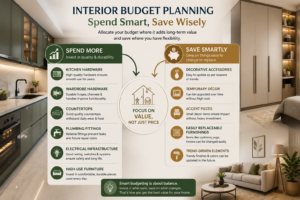
You may choose more economical options for:
-
Decorative accessories
-
Temporary décor
-
Certain accent pieces
-
Easily replaceable furnishings
-
Trend-driven elements
This gives you flexibility without compromising the core functionality of the home.
Don’t Choose Materials Based Only on Price
The cheapest quotation is not necessarily the most economical project.
Two interior quotations may look similar but contain completely different specifications.
For example, compare:
-
Board thickness
-
Surface finish
-
Hardware brand
-
Drawer channels
-
Hinges
-
Countertop material
-
Internal cabinet construction
-
Paint system
-
Electrical specifications
-
Installation quality
A lower initial price can become expensive if the material needs early replacement or if important components are excluded.
Always compare specification against specification, not just total price against total price.
Understand What Is Included in Your Interior Quote
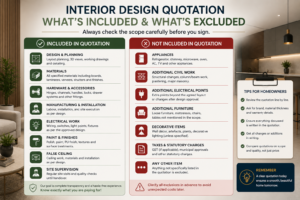
Before signing an interior contract, ask for a clearly defined scope of work.
Your quotation should ideally explain:
-
Design services included
-
Number of design revisions
-
Materials and brands
-
Hardware specifications
-
Quantity or area wherever applicable
-
Installation charges
-
Civil work
-
Electrical work
-
Plumbing work
-
Painting
-
False ceiling
-
Transportation
-
Site supervision
-
Taxes
-
What is specifically excluded
This prevents the common situation where a project appears affordable initially but becomes considerably more expensive through additions later.
Turnkey Interior vs Contractor-Based Work
One of the important decisions in interior projects is whether to appoint a turnkey interior designer or manage different contractors yourself.
Turnkey Interior Design
A turnkey company generally manages multiple aspects of the project under one coordinated scope.
Advantages
-
Single point of coordination
-
Better integration between design and execution
-
Easier project management
-
Less coordination required from the homeowner
-
Greater control over the overall design
Disadvantages
-
Initial quotation may appear higher
-
You need to carefully understand the scope and specifications
Multiple Contractors
You may appoint separate contractors for carpentry, electrical, painting, civil work and other requirements.
Advantages
-
Greater direct control over individual contractors
-
Potential to negotiate individual costs
-
Flexibility in selecting vendors
Disadvantages
-
More coordination
-
Greater responsibility for the homeowner
-
Scheduling conflicts can occur
-
Quality responsibility may become fragmented
-
Design changes can create coordination problems
The right choice depends on how much time and involvement you are willing to put into managing the project.
Keep a Contingency Budget
Never allocate 100% of your available money to the planned work.
Keep a contingency amount for unexpected requirements.
Possible surprises include:
-
Plumbing problems
-
Electrical modifications
-
Uneven walls or floors
-
Additional civil work
-
Changes requested during execution
-
Replacement of existing infrastructure
-
Additional storage
-
Site-related expenses
A contingency gives you breathing room and reduces the pressure to compromise when something unexpected happens.
How to Reduce Interior Costs Without Reducing Quality
Cost management does not mean cutting quality everywhere.
Instead, identify where you can simplify the design.
1. Reduce unnecessary civil work
Changing walls, flooring and plumbing can significantly increase complexity and cost.
If the existing layout works well, retaining it may be more economical.
2. Standardize materials
Using too many different finishes can increase procurement, wastage and installation complexity.
A controlled material palette can look more sophisticated while simplifying execution.
3. Prioritize storage
Don’t build storage simply because there is an empty wall.
Design storage based on actual requirements.
4. Avoid excessive decorative details
Intricate profiles, unnecessary panelling and highly detailed ceiling designs can increase both material and labour costs.
5. Plan electrical points early
Adding electrical points after finishing work can result in additional labour and damage to completed surfaces.
6. Avoid frequent design changes
Every late change can affect materials, labour, timelines and other connected elements.
Finalize important decisions before execution begins.
Don’t Cut Costs on These Areas
Some savings can become false economies.
Be cautious about compromising on:
-
Kitchen and wardrobe hardware
-
Electrical wiring and safety components
-
Plumbing infrastructure
-
Waterproofing
-
Countertop quality
-
Structural or civil work
-
High-use hinges and channels
-
Installation quality
A decorative element can be changed later.
Poor infrastructure is much harder and more expensive to correct.
How to Compare Two Interior Design Quotes
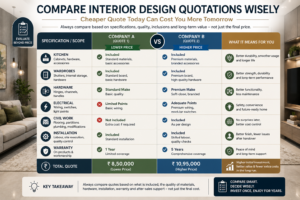
Suppose you receive two quotations:
Company A: ₹X
Company B: ₹Y
Do not immediately choose Company A simply because it is cheaper.
Create a comparison sheet covering:
-
Materials
-
Board specifications
-
Finishes
-
Hardware
-
Kitchen scope
-
Wardrobe scope
-
Furniture
-
Electrical
-
Lighting
-
Ceiling
-
Civil work
-
Painting
-
Design services
-
Installation
-
Taxes
-
Exclusions
-
Warranty
-
Project timeline
Only after comparing these points can you determine which quotation actually offers better value.
Common Interior Budgeting Mistakes
Starting without a maximum budget
Without a ceiling, design decisions can continue expanding indefinitely.
Choosing finishes before planning the scope
Premium finishes cannot compensate for poor space planning.
Comparing only the total quotation
A cheaper quotation may simply contain fewer items or lower specifications.
Forgetting exclusions
Always ask what the quotation does not include.
Spending too much on aesthetics
Beautiful finishes are useful, but infrastructure and functionality should come first.
Making changes during execution
Late changes can affect cost, timeline and other completed work.
Not keeping contingency money
Unexpected expenses are easier to manage when you have already planned for them.
A Simple Interior Budget Planning Formula
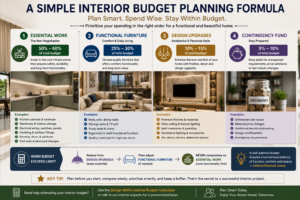
Before starting your project, divide your available budget into four broad groups:
1. Essential work
Kitchen, wardrobes, electrical, plumbing, flooring and other necessary work.
2. Functional furniture
Beds, sofa, dining table, storage and other everyday requirements.
3. Design upgrades
Premium finishes, feature walls, lighting details, decorative elements and upgraded materials.
4. Contingency
Money kept aside for unexpected requirements.
If your initial estimate exceeds your budget, reduce the design upgrades first, rather than compromising essential infrastructure.
Interior Budget Planning Checklist
Before starting the project, make sure you have:
-
Defined your maximum budget
-
Listed all required rooms
-
Identified storage requirements
-
Finalized the broad layout
-
Defined the material specifications
-
Compared quotations properly
-
Checked inclusions and exclusions
-
Planned electrical and plumbing work
-
Decided between turnkey and multiple contractors
-
Kept a contingency amount
-
Finalized major design decisions before execution
Final Verdict
Good interior design is not about spending the maximum amount of money. It is about spending the available money intelligently.
A well-planned budget helps you prioritize functionality, select appropriate materials, avoid unnecessary changes and reduce unpleasant financial surprises during execution.
Before comparing interior designers on price alone, compare their scope, specifications, materials, execution responsibility and exclusions.
The cheapest interior quotation is not always the lowest-cost solution in the long run.
The better question is:
“What quality, functionality and service am I getting for the money I am spending?”
That is the foundation of effective interior design budget planning and cost management in India.
At Design Within, we believe a beautiful interior should not only look good when it is completed — it should also perform well for years.
Before we dive into more details about Interior Design Budget Planning & Cost Management in India, it might be helpful to estimate how much your interior design project could cost. Understanding your budget can help you make more informed decisions about what features to prioritize. To get a better idea, you can use our ‘interior design budget calculator’ budget calculator and start planning your dream home today.
Frequently Asked Questions
1. How much should I budget for interior design in India?
There is no single fixed cost because the budget depends on the size of the home, number of rooms, storage requirements, materials, finishes, furniture, electrical work, civil work and level of customization. The best approach is to define your total budget first and then allocate it according to priorities.
2. What is the biggest mistake when planning an interior design budget?
The biggest mistake is starting the project without a clearly defined budget and scope of work. Homeowners may make design decisions first and discover later that the total cost is much higher than expected. A detailed scope and realistic budget should be established before execution begins.
3. How much contingency should I keep for an interior project?
It is advisable to keep some money aside for unexpected requirements rather than allocating your entire budget to planned work. The exact amount depends on the condition of the property, scope of renovation and complexity of the project. A contingency provides flexibility when unforeseen site conditions or design changes arise.
4. Is a turnkey interior project more expensive than hiring individual contractors?
Not necessarily. A turnkey quotation may initially appear higher because it can include design, coordination, procurement and execution under one scope. With individual contractors, some costs may be lower, but the homeowner takes on more responsibility for coordination, scheduling and quality control. The correct comparison is based on the complete scope and specifications, not just the final quotation.
5. How can I reduce my interior design cost without compromising quality?
Start by reducing unnecessary civil work and excessive decorative details. Standardizing materials, planning electrical points early, avoiding frequent design changes and prioritizing essential work can also control costs. It is generally better to simplify decorative elements than compromise on important infrastructure or frequently used components.
6. Why do two interior design quotations have different prices?
Different quotations may use different materials, hardware, finishes, construction methods and levels of customization. One quotation may also exclude certain work that another company has included. Always compare the specifications, inclusions and exclusions before deciding which quotation offers better value.
7. Which areas of home interiors should I not compromise on?
Avoid compromising excessively on high-use or difficult-to-replace components such as electrical work, plumbing, waterproofing, kitchen and wardrobe hardware, countertops and installation quality. Saving money on these areas can result in higher maintenance or replacement costs later.
8. Should I choose materials before fixing my interior budget?
No. It is better to establish the overall budget and project requirements first. Once you know how much you can invest, materials and finishes can be selected according to your priorities. This prevents the design from exceeding your financial limits.
9. How can I compare interior designers based on their quotations?
Compare more than the total price. Check the materials, board specifications, hardware, finishes, kitchen and wardrobe scope, electrical work, lighting, civil work, furniture, installation, taxes, warranty, timeline and exclusions. A detailed comparison will show whether the lower quotation actually provides equivalent specifications.
10. How can I prevent my interior project from going over budget?
Define the scope before execution, finalize major design decisions early, compare detailed quotations, confirm material specifications and maintain a contingency budget. Most importantly, avoid frequent changes after work has started because even small changes can affect materials, labour, timelines and related work.