Introduction
Choosing the right wardrobe door system may seem like a small interior-design decision, but it can significantly affect how comfortably a bedroom works.
The two most common options are sliding wardrobes and hinged wardrobes. Both can provide excellent storage, but they differ in the way they use floor space, how easily you can access the interiors, how they are maintained and how they fit into different bedroom layouts.
So, which is better?
The answer depends on your room size, available clearance, storage requirements and personal preference.
This guide compares sliding and hinged wardrobes to help you make the right decision for your Indian home.
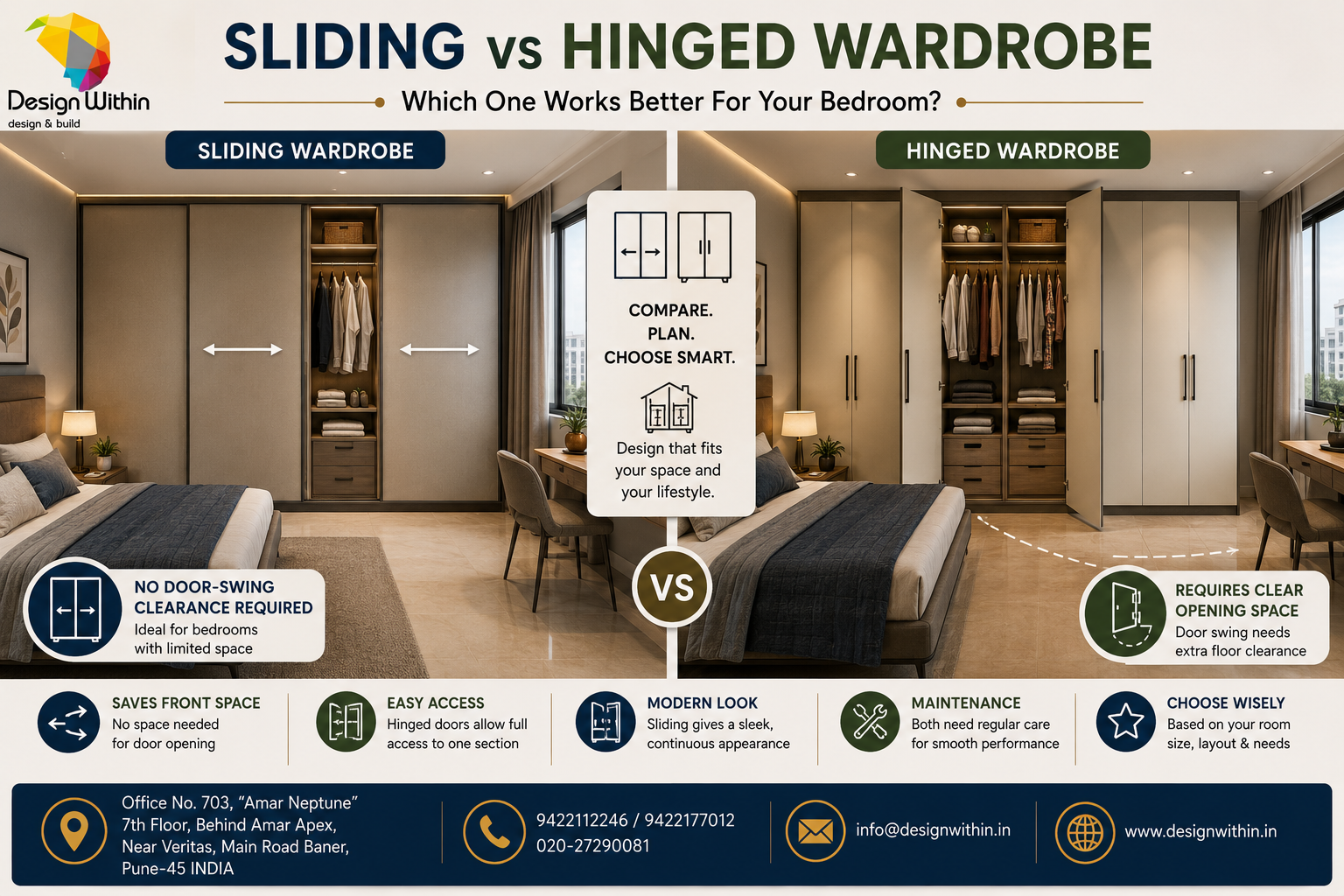
Sliding vs Hinged Wardrobe: Quick Comparison
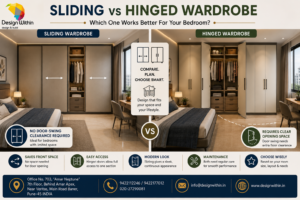
| Feature | Sliding Wardrobe | Hinged Wardrobe |
|---|---|---|
| Floor space in front | Requires less clearance | Requires clearance for shutters |
| Access to wardrobe | Usually partial access at one time | Full access to one section |
| Storage visibility | Some sections remain hidden | Entire opened section visible |
| Small bedrooms | Often suitable | Can be difficult if clearance is limited |
| Maintenance | Tracks need cleaning and adjustment | Hinges need maintenance |
| Design flexibility | Excellent for large, continuous fronts | Excellent for segmented designs |
| Door movement | Slides sideways | Opens outward |
| Internal access | Depends on shutter position | Generally easier |
| Best for | Space-constrained bedrooms | Rooms with sufficient clearance |
The important point is that sliding does not automatically mean better for small rooms, and hinged does not automatically mean better for storage. The actual room layout matters more than the door style alone.
What Is a Sliding Wardrobe?
A sliding wardrobe uses two or more shutters that move horizontally along tracks.
Instead of opening into the bedroom, the shutters move sideways.
This makes sliding wardrobes particularly useful when there is limited space between the wardrobe and the bed or another piece of furniture.
Advantages of Sliding Wardrobes
-
Require less floor clearance in front
-
Work well in compact bedrooms
-
Can create a clean, contemporary appearance
-
Allow large continuous wardrobe fronts
-
Can accommodate mirrors, glass or decorative finishes
-
Reduce interference with nearby furniture when the doors are opened
For modern apartments where bedroom space is often limited, this can be a significant advantage.
Disadvantages of Sliding Wardrobes
-
You cannot normally access the entire wardrobe at once
-
One section remains behind another shutter
-
Tracks can collect dust
-
Poor-quality rollers or tracks can affect smooth operation
-
Repairing the sliding mechanism may be more involved than replacing a simple hinge
A sliding wardrobe therefore saves floor clearance, but it does not necessarily provide better internal storage.
What Is a Hinged Wardrobe?
A hinged wardrobe uses shutters attached to the cabinet through hinges. The doors open outward into the room.
This is the more traditional wardrobe configuration and remains highly practical.
Advantages of Hinged Wardrobes
-
Easy access to the full wardrobe section
-
Entire contents can be visible when doors are opened
-
Internal drawers and accessories are generally easier to access
-
Simple and familiar mechanism
-
Wide range of door styles available
-
Individual shutters can be opened independently
Disadvantages of Hinged Wardrobes
-
Requires clear space in front of the wardrobe
-
Open shutters can interfere with beds, chairs or other furniture
-
Can feel inconvenient in narrow bedrooms
-
Door swing needs to be considered during furniture planning
For a bedroom with adequate clearance, however, these disadvantages may not matter.
Sliding vs Hinged Wardrobe: Which Uses Space Better?
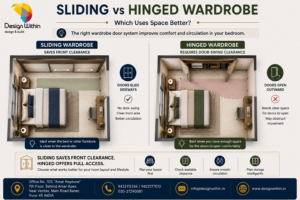
This is probably the most common reason homeowners choose sliding wardrobes.
A sliding wardrobe does not need the additional floor area required for a door to swing open.
For example, if a bed is positioned relatively close to the wardrobe, a hinged door may become inconvenient because the shutter needs sufficient clearance to open.
A sliding wardrobe avoids this door-swing issue.
However, remember that the wardrobe itself still requires adequate depth and internal planning.
Sliding doors save front clearance; they do not magically create additional wardrobe depth.
Which Wardrobe Gives Better Access?
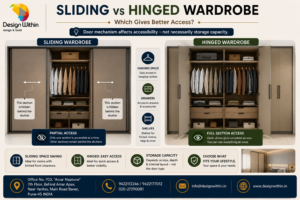
Here, hinged wardrobes generally have an advantage.
When a hinged shutter is opened, the entire corresponding section is accessible.
You can see:
-
Shelves
-
Drawers
-
Hanging space
-
Accessories
-
Lower storage
With sliding wardrobes, one shutter generally overlaps another section. This means you may need to move the shutter to access different portions.
If easy visibility and quick access are your priorities, hinged wardrobes may be preferable.
Which Is Better for Small Bedrooms?
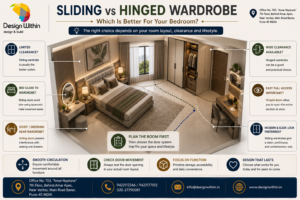
For a compact bedroom, sliding wardrobes are often a practical choice because they don’t require the same front clearance as hinged shutters.
They can work particularly well when:
-
The bed is close to the wardrobe
-
The passage is narrow
-
A study table is positioned nearby
-
The room has limited circulation space
-
Furniture is arranged along multiple walls
However, don’t choose sliding doors solely because the room is small.
First create the complete furniture layout.
If there is enough clearance for hinged shutters to open comfortably without obstructing movement, a hinged wardrobe may still be the better option.
Which Wardrobe Is Better for Storage?
The door mechanism itself does not determine how much storage you get.
Storage depends more on:
-
Wardrobe width
-
Height
-
Depth
-
Internal layout
-
Shelves
-
Drawers
-
Hanging sections
-
Accessories
-
Overhead storage
A well-designed hinged wardrobe can provide excellent storage.
A poorly planned sliding wardrobe can waste valuable internal space.
Therefore, focus on the internal organization first and the door mechanism second.
Sliding vs Hinged Wardrobe: Maintenance
Both systems require maintenance, but the maintenance is different.
Sliding wardrobe
The main areas to monitor are:
-
Tracks
-
Rollers
-
Alignment
-
Dust accumulation
-
Shutter movement
Regular cleaning of tracks can help maintain smooth operation.
Hinged wardrobe
Maintenance generally focuses on:
-
Hinges
-
Shutter alignment
-
Handle fittings
-
Soft-close mechanisms
The quality of hardware matters considerably in both systems.
A premium door mechanism installed poorly can still perform badly, while good-quality hardware with proper installation can provide long-term reliability.
Which Wardrobe Looks More Modern?
This is largely a matter of design rather than functionality.
Sliding wardrobes can create a particularly clean, uninterrupted appearance because large shutters can form one continuous visual surface.
Popular finishes include:
-
Laminate
-
Veneer
-
Acrylic
-
Glass
-
Mirror
-
PU finishes
Hinged wardrobes offer equally broad design possibilities.
You can use:
-
Different shutter colours
-
Fluted panels
-
Profile handles
-
Handle-less designs
-
Veneer
-
Laminate
-
Glass
-
Decorative mouldings
The wardrobe should therefore be selected as part of the overall bedroom design, rather than purely for its door mechanism.
What About Wardrobe Height?
In Indian homes, the vertical space above the main wardrobe can be valuable.
A practical solution can be a full-height wardrobe with overhead storage integrated into the design.
For example:
Main wardrobe (about 7foot)+ overhead storage
This can provide additional space for luggage, seasonal clothing and less frequently used items without occupying additional floor area.
Whether the doors are sliding or hinged, the important consideration is how comfortably the upper storage can be accessed and organized.
Sliding vs Hinged Wardrobe: Which Is More Cost-Effective?
There is no universal answer.
The final cost depends on:
-
Wardrobe size
-
Board material
-
Finish
-
Hardware
-
Number of shutters
-
Sliding mechanism
-
Hinges
-
Internal accessories
-
Drawers
-
Installation
-
Customization
Sliding wardrobes involve specialized tracks and rollers, while hinged wardrobes use hinges and conventional shutter hardware.
Rather than comparing only the door system, compare the complete wardrobe specification.
When Should You Choose a Sliding Wardrobe?
A sliding wardrobe may be the better choice when:
-
Bedroom space is limited
-
The bed is close to the wardrobe
-
Door swing would obstruct circulation
-
You prefer a continuous modern appearance
-
You want large mirrored or glass fronts
-
The room has limited clearance in front of the wardrobe
When Should You Choose a Hinged Wardrobe?
A hinged wardrobe may be preferable when:
-
The bedroom has sufficient clearance
-
Easy access is important
-
You want to see an entire wardrobe section at once
-
You prefer simpler door mechanisms
-
The wardrobe is positioned away from other furniture
-
You want greater flexibility in opening individual sections
Common Wardrobe Planning Mistakes
Choosing the door type before planning the room
The wardrobe should be planned along with the bed, dressing table, study table and circulation.
Ignoring door clearance
A hinged wardrobe needs enough space for the shutter to open comfortably.
Focusing only on the exterior
A beautiful wardrobe with poor internal organization will become frustrating to use.
Not planning overhead storage
The vertical space above a wardrobe can be valuable, particularly in apartments with limited storage.
Choosing hardware only on price
Tracks, rollers and hinges directly affect everyday usability.
Making the wardrobe unnecessarily deep
More depth does not automatically mean better storage. Poorly organized deep storage can actually make items harder to access.
So, Sliding or Hinged Wardrobe—Which Is Better?
There is no universal winner.
Choose sliding if:
Space efficiency and front clearance are your biggest concerns.
Choose hinged if:
Easy access and full visibility of the wardrobe are more important.
For many compact Indian bedrooms, sliding wardrobes are a practical solution. For rooms with comfortable circulation space, hinged wardrobes can offer simpler access and excellent functionality.
The best choice should be made after planning the complete bedroom layout, not before it.
A good wardrobe is not simply one that looks attractive. It should provide the right amount of storage, be easy to use, suit the available space and remain practical for years.
At Design Within, we believe a beautiful interior should not only look good when it is completed — it should also perform well for years.
Before we dive into more details about sliding vs Hinged Wardrobe, it might be helpful to estimate how much your interior design project could cost. Understanding your budget can help you make more informed decisions about what features to prioritize. To get a better idea, you can use our ‘interior design budget calculator’ budget calculator and start planning your dream home today.
Frequently Asked Questions
1. Which is better, sliding or hinged wardrobe?
Neither is universally better. Sliding wardrobes are generally better when front clearance is limited, while hinged wardrobes offer easier access and full visibility when opened. The bedroom layout should determine the choice.
2. Are sliding wardrobes good for small bedrooms?
Yes. Sliding wardrobes can work well in compact bedrooms because the shutters do not swing into the room. However, the complete furniture layout should be checked before selecting them.
3. Do hinged wardrobes provide more storage than sliding wardrobes?
Not necessarily. Storage capacity depends primarily on wardrobe dimensions and internal organization. Hinged wardrobes can provide easier access to their contents, but the door type itself does not determine total storage capacity.
4. Are sliding wardrobes more expensive than hinged wardrobes?
They can be, depending on the sliding mechanism, hardware, finishes and customization. The overall wardrobe specification should be compared rather than assuming one door type will always cost more.
5. Which wardrobe is easier to maintain?
Both can be easy to maintain when good-quality hardware is used. Sliding wardrobes require attention to tracks and rollers, while hinged wardrobes require maintenance of hinges and alignment.
6. Can sliding wardrobes have overhead storage?
Yes. Sliding wardrobes can be designed with overhead storage above the main wardrobe, which is useful for luggage, seasonal items and less frequently used belongings.
7. Are hinged wardrobes outdated?
No. Hinged wardrobes remain highly practical and can be designed in contemporary, minimalist and luxury styles. Their suitability depends on the room layout rather than whether the design is modern.
8. Can I use mirrors on a sliding wardrobe?
Yes. Mirrors, glass and other finishes can be incorporated into sliding wardrobe shutters. However, the material and hardware should be selected according to the shutter size and weight.
9. What is more important: wardrobe design or wardrobe hardware?
Both matter. A well-designed wardrobe with poor-quality hardware can become difficult to use, while good hardware cannot compensate for poor internal planning. The complete system should be considered together.
10. How should I decide between sliding and hinged wardrobes?
Start with your bedroom layout. Check the distance between the wardrobe and other furniture, available circulation, storage requirements and how you prefer to access your clothes. Then choose the door system that best fits those requirements.