Introduction:
False Ceiling Installation: Process, Labour Cost, Time & What’s Included
A false ceiling may look simple once it is finished, but achieving a clean and durable result requires proper planning and execution.
From the metal framework and electrical wiring to gypsum boards, joint finishing, painting and lighting, every stage needs to be coordinated correctly.
Whether you are installing a false ceiling in a living room, bedroom or entire home, understanding the process helps you know what you are paying for and what to expect during execution.
Here is a simple overview of the false ceiling installation process.
Step 1: Site Measurement & Ceiling Planning
The process begins with measuring the room and inspecting the existing ceiling.
The designer or contractor checks:
-
Existing ceiling height
-
Beam locations
-
Electrical points
-
AC requirements
-
Fan positions
-
Lighting requirements
-
Ceiling design and levels
The final design should be decided before installation begins.
This is also the stage where the required ceiling height and lighting layout are coordinated.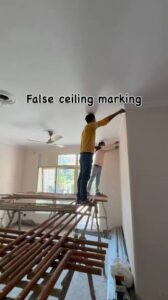
Step 2: Marking the Ceiling Levels
Once the design is finalised, the required ceiling level is marked on the walls.
This determines the final height of the false ceiling.
Accurate marking is important because even a small variation can become noticeable across a large ceiling.
Step 3: Installing the Metal Framework
A metal framework is fixed to the existing structure to create the supporting skeleton for the false ceiling.
The framework needs to be:
-
Properly levelled
-
Correctly spaced
-
Firmly anchored
-
Suitable for the selected ceiling system
The quality of the framework is extremely important because the finished gypsum surface depends on the stability of this structure.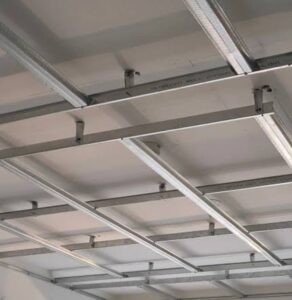
Step 4: Electrical & Service Coordination
Before closing the ceiling, electrical and other services are positioned above the framework.
This can include:
-
Light wiring
-
Downlight points
-
LED strip wiring
-
Profile-light wiring
-
Fan wiring
-
AC-related services
-
Other electrical requirements
This stage should be coordinated carefully because making changes after the ceiling is closed can involve unnecessary rework.
Step 5: Fixing the Gypsum Boards
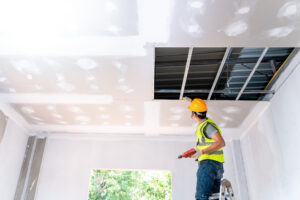
Gypsum boards are then cut and fixed to the prepared framework.
The boards are installed according to the approved ceiling design.
For curved or more complex designs, additional detailing and specialised execution may be required.
For ceilings using plywood, veneer or laminate features, those components are installed according to the specific design and material specification.
Step 6: Joint Treatment & Surface Finishing
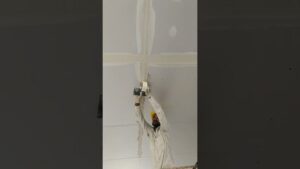
After the boards are installed, the joints and screw heads are treated.
The surface is then prepared for finishing.
This stage is critical for achieving a smooth and seamless ceiling.
Poor joint treatment can result in visible lines, cracks or uneven surfaces after painting.
Step 7: Primer & Painting
Once the surface is properly finished and prepared, primer and paint are applied.
The final colour should ideally be selected as part of the overall interior design rather than as a separate decision.
White or light neutral shades are common, but feature ceilings can also use different colours depending on the design.
Step 8: Lighting Installation
Finally, the selected lighting fixtures are installed.
Depending on the design, this may include:
-
Recessed downlights
-
LED strips
-
Cove lighting
-
Profile lights
-
Spotlights
-
Pendant lights
The lighting should be tested after installation to check alignment, brightness and overall effect.
How Long Does False Ceiling Installation Take?
The timeline depends on the size and complexity of the project.
For a standard residential room, the physical ceiling work may take approximately 3–7 days, excluding delays related to other trades, material availability, painting or electrical work.
A larger home or a more complex ceiling with multiple levels, curves, plywood features and integrated lighting can take longer.
A realistic project schedule should therefore be prepared based on the actual design and scope, rather than assuming a fixed number of days.
What Is Included in False Ceiling Work?
Before accepting a quotation, check exactly what is included.
A typical false ceiling scope may include:
-
Site measurement
-
Ceiling marking
-
Metal framework
-
Gypsum boards
-
Screws and accessories
-
Joint treatment
-
Basic finishing
-
Primer/painting, if specified
-
Labour
However, many quotations may exclude:
-
Electrical wiring
-
LED strips
-
Drivers
-
Profile lights
-
Downlights
-
Decorative light fixtures
-
Plywood
-
Veneer
-
Laminate
-
Wallpaper
-
Additional civil work
Always compare quotations based on the complete specification, not simply the price per square foot.
False Ceiling Labour Cost
Labour is usually either included in the overall per-square-foot rate or quoted separately.
The labour component depends on:
-
Ceiling material
-
Design complexity
-
Number of levels
-
Curves and detailing
-
Ceiling height
-
Site conditions
-
Location
-
Finishing requirements
A simple gypsum ceiling will generally require less labour than a highly detailed ceiling involving multiple materials and custom features.
For Pune projects, it is better to obtain a detailed site-specific quotation rather than relying on a generic labour rate.
What About Gypsum + Plywood Ceilings?
Modern false ceilings are not limited to a single material.
A ceiling can combine:
Gypsum + plywood + veneer
or
Gypsum + plywood + laminate
For example, the main ceiling can be constructed in gypsum while selected sections use plywood finished with veneer.
Wallpaper can also be applied over a properly prepared gypsum surface.
These combinations require additional coordination and should be included in the design and quotation from the beginning.
5 Things to Check Before Starting False Ceiling Work
1. Final ceiling design
Don’t start work based only on a rough sketch.
2. Lighting layout
All lighting positions should be finalised before closing the ceiling.
3. Ceiling height
Confirm the final finished height.
4. Material specification
Know exactly which gypsum board, framework and finishing system is being used.
5. Complete quotation
Check inclusions and exclusions so there are no surprises later.
How Design Within Approaches False Ceiling Installation
At Design Within, false ceiling design and execution are planned together with the overall interior.
The ceiling is coordinated with:
-
Furniture
-
Lighting
-
Electrical work
-
AC and services
-
Wall treatments
-
Material finishes
-
Final ceiling height
This approach helps ensure that the finished ceiling is not only visually attractive but also properly coordinated with the rest of the home.
Final Thoughts
A good false ceiling is the result of good design + correct materials + accurate execution.
The basic process is:
Measure → Mark → Framework → Electrical → Board Installation → Joint Finishing → Paint → Lighting
The exact timeline and cost depend on the size, design, materials and site conditions.
Before starting, make sure the design, ceiling height, lighting and quotation are finalised.
That simple planning step can prevent a significant amount of rework later.
If you are planning a false ceiling as part of a home interior in Pune, Design Within can help coordinate the design, materials, lighting and execution as one complete interior-design process.
At Design Within, we believe a beautiful interior should not only look good when it is completed — it should also perform well for years.
Before we dive into more details about designing your furniture, it might be helpful to estimate how much your interior design project could cost. Understanding your budget can help you make more informed decisions about what features to prioritize. To get a better idea, you can use our ‘interior design budget calculator’ budget calculator and start planning your dream home today.
Frequently Asked Questions
How long does false ceiling installation take?
A standard residential room may take approximately 3–7 days for the main ceiling work, although the complete process can take longer depending on finishing, painting, electrical work and design complexity.
What comes first, electrical work or false ceiling?
Electrical and service planning should happen before the ceiling is closed, so wiring and light positions can be properly coordinated.
How is a gypsum false ceiling installed?
The general process is measurement and marking, metal framework installation, service coordination, gypsum-board fixing, joint treatment, surface finishing, painting and lighting installation.
Is painting included in false ceiling cost?
It depends on the quotation. Always confirm whether primer and final paint are included.
Is lighting included in false ceiling work?
Not necessarily. LED strips, downlights, profile lights, drivers and decorative fixtures may be charged separately.
Can plywood and gypsum be used together?
Yes. Gypsum can be combined with plywood finished with veneer or laminate to create premium feature ceilings.
Can wallpaper be applied to a false ceiling?
Yes. Wallpaper can be applied to a properly finished gypsum surface when the design and surface preparation are suitable.