
Introduction :
Engineered Wood vs Solid Wood Flooring: Which Is Better for Indian Homes?
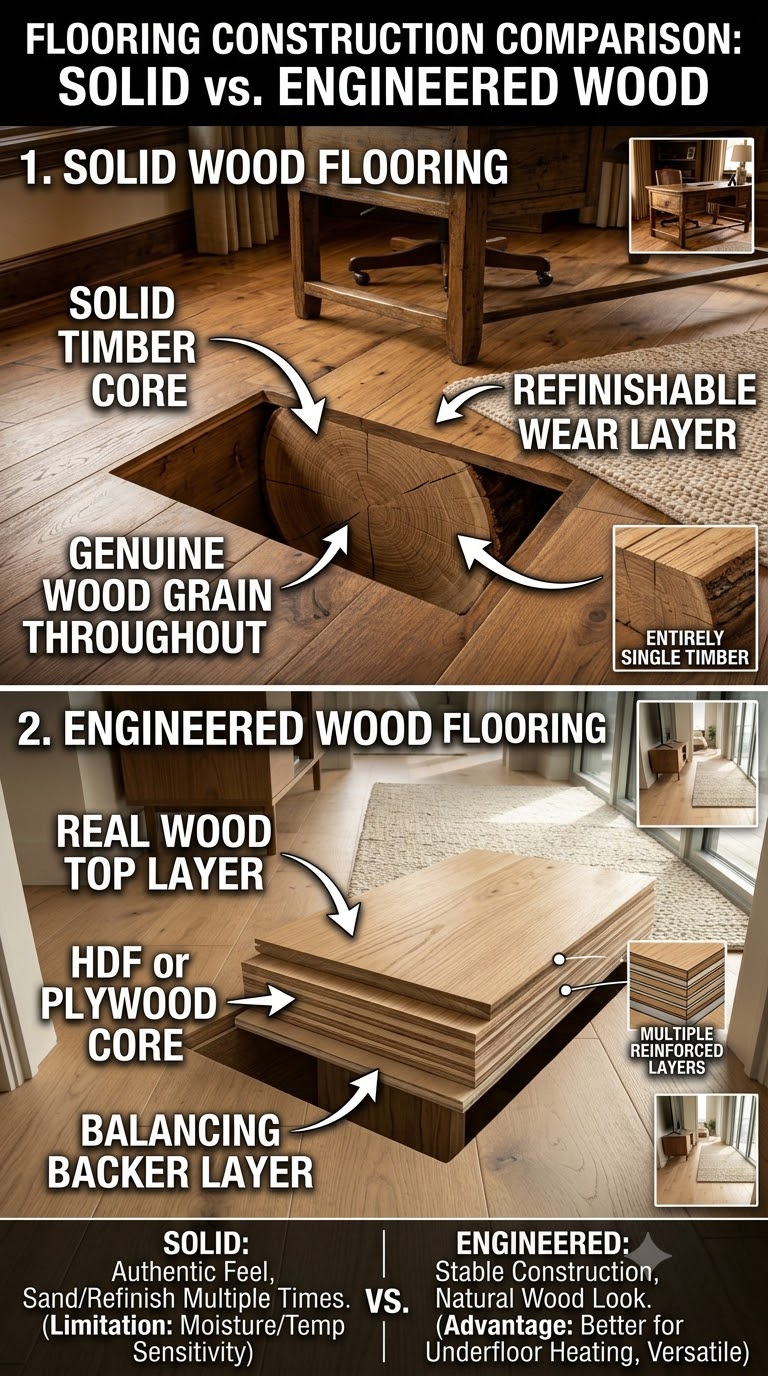
When choosing wooden flooring, one of the first decisions is whether to choose solid wood or engineered wood.
Both are genuine wood products, but their construction, stability, maintenance and suitability for different spaces can vary significantly.
Solid wood offers the authenticity and character of natural timber. Engineered wood combines a real-wood top layer with a multi-layer construction that can provide greater dimensional stability.
So which is better for an Indian home?
There is no universal winner. The right choice depends on where you are installing it, your budget, maintenance expectations and the look and feel you want.
Engineered Wood vs Solid Wood: At a Glance
| Factor | Solid Wood | Engineered Wood |
|---|---|---|
| Construction | Natural wood throughout | Real wood top layer + engineered core |
| Appearance | Genuine wood | Genuine wood surface |
| Natural character | Excellent | Excellent |
| Dimensional stability | Lower | Generally higher |
| Moisture sensitivity | Higher | Generally better |
| Refinishing | Often possible | Possible on suitable products |
| Installation | More involved | Often easier |
| Maintenance | Medium to high | Medium |
| Cost | Medium to high | Medium to high |
| Best for | Premium interiors | Versatile residential applications |
What Is Solid Wood Flooring?
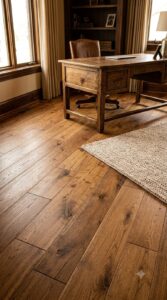
Solid wood flooring is made from a single piece of natural timber.
The entire plank is genuine wood, giving it natural grain, variation and depth.
Different species and finishes can produce very different appearances.
One of its major advantages is that suitable solid wood flooring can often be sanded and refinished multiple times, depending on the thickness and construction.
Best suited for:
- Premium bedrooms
- Living rooms
- Studies
- Luxury residences
- Feature interiors
What Is Engineered Wood Flooring?

Engineered wood has a real wood top layer combined with multiple underlying layers.
The construction is designed to improve dimensional stability compared with a solid wood plank.
This makes engineered wood an attractive option where homeowners want genuine wood but also want a flooring system that can better accommodate changes in environmental conditions.
Best suited for:
- Bedrooms
- Living rooms
- Studies
- Apartments
- Premium residential interiors
- Selected renovation projects
1. Appearance
Both options provide genuine wood at the visible surface.
Solid wood has natural variations throughout the plank, while engineered wood uses a real-wood top layer.
Therefore, visually, a high-quality engineered wood floor can look very similar to a solid wood floor.
Winner: Tie
The difference is more about construction and performance than appearance.
2. Stability in Indian Conditions
This is one of the most important considerations.
Wood naturally responds to changes in temperature and humidity.
Solid wood can experience more movement because the entire plank consists of natural timber.
Engineered wood is constructed in multiple layers, which can provide greater dimensional stability.
This does not make engineered wood immune to environmental changes. Correct installation, acclimatisation and subfloor preparation are still essential.
Advantage: Engineered wood
3. Durability
Both can be highly durable when properly selected and maintained.
Solid wood has an important advantage: many solid wood floors can be sanded and refinished several times.
Engineered wood can also potentially be refinished, but this depends on the thickness of its real-wood wear layer.
Therefore, don’t assume every engineered floor can be refinished repeatedly.
Winner: Depends on product construction.
4. Maintenance
Neither flooring should be treated like vitrified tiles.
Both require protection from excessive moisture and careful cleaning.
Regular dust removal, prompt cleaning of spills and appropriate furniture protection are important.
Engineered wood may offer a practical advantage in environments where dimensional stability is a concern, but it still requires proper care.
Winner: Slight advantage to engineered wood.
5. Installation
Engineered wood is available in flooring systems that can offer relatively straightforward installation, depending on the product.
Solid wood installation can require more specialised preparation and installation techniques.
The existing floor, moisture conditions and installation method all matter.
Winner: Engineered wood
6. Cost
There is no fixed price for either category.
Cost depends on:
- Wood species
- Grade
- Thickness
- Finish
- Construction
- Brand
- Pattern
- Installation method
Premium engineered wood can cost as much as or more than some solid wood products.
So don’t assume that engineered automatically means cheaper.
The correct comparison is between products with similar quality and specifications.
Which Is Better for Bedrooms?
Both can work exceptionally well in bedrooms.
If you want the maximum natural character and the ability to potentially refinish the floor multiple times, solid wood is attractive.
If you want genuine wood combined with greater dimensional stability and potentially simpler installation, engineered wood may be the more practical option.
For many modern apartments, engineered wood is a particularly sensible choice.
Which Is Better for a 2BHK or 3BHK?
The answer depends on how much of the home you want to cover.
For a 2BHK or 3BHK, many homeowners choose wooden flooring selectively rather than installing it throughout the entire home.
For example:
Bedrooms → Engineered wood
Living & dining → Marble / vitrified tile
Kitchen → Vitrified tile
Bathrooms → Suitable anti-skid tiles
This approach can provide the warmth of wood while keeping the overall flooring budget under control.
What About a 4BHK or Villa?
Larger homes offer more opportunities to combine materials.
In a 4BHK or villa, solid or engineered wood can be used selectively in:
- Master bedroom
- Children’s bedrooms
- Guest bedroom
- Study
- Family lounge
- Dressing areas
Large common areas can use marble, vitrified tiles or another suitable flooring material.
The goal isn’t to use expensive flooring everywhere.
The goal is to use the right material in the right space.
Solid Wood vs Engineered Wood: Pros & Cons
Solid Wood
Pros
- 100% natural wood construction
- Unique grain and character
- Can often be refinished
- Premium appearance
- Long design life when properly maintained
Cons
- More sensitive to environmental changes
- Requires greater care
- Installation can be more involved
- Premium species can be expensive
Engineered Wood
Pros
- Genuine wood surface
- Generally better dimensional stability
- Wide range of finishes
- Suitable for many residential applications
- Installation can be relatively straightforward
Cons
- Not all products can be refinished repeatedly
- Quality varies significantly
- Still sensitive to moisture
- Premium products can be expensive
Common Mistakes When Choosing
Assuming engineered wood isn’t real wood
It has a genuine wood top layer. It is different from laminate or SPC.
Choosing based only on thickness
Thickness alone doesn’t tell you everything about flooring quality.
Ignoring the wear layer
For engineered wood, the thickness of the real-wood top layer matters if future refinishing is important.
Ignoring moisture
Neither flooring should be selected without considering the room’s moisture conditions.
Choosing by appearance alone
Two floors may look similar but perform differently because of their construction.
So, Which One Should You Choose?
Choose solid wood if you want:
Maximum natural character + genuine traditional construction + potential for repeated refinishing
Choose engineered wood if you want:
Genuine wood + greater dimensional stability + practical installation
For many Indian residential projects, engineered wood offers the more balanced solution.
But for a premium interior where authentic natural timber and long-term refinishing are major priorities, solid wood remains an excellent choice.
Final Thoughts
The choice between engineered wood and solid wood is not simply about which material is more luxurious.
It is about construction, stability, maintenance, installation and how the floor will be used.
Solid wood offers the timeless appeal of natural timber throughout the plank.
Engineered wood offers a genuine wood surface combined with a construction designed for greater stability.
For Indian homes, particularly apartments where environmental conditions and installation constraints need to be considered carefully, engineered wood can often be the more practical choice.
However, there is no reason to use the same flooring everywhere.
A well-designed home can combine wood, marble, vitrified tiles, SPC or other flooring materials to achieve the right balance of aesthetics, performance and cost.
At Design Within, flooring is selected as part of the complete interior design—not as an isolated material decision.
The best flooring is not necessarily the most expensive. It is the one that performs correctly in the space where you use it.
At Design Within, we believe a beautiful interior should not only look good when it is completed — it should also perform well for years.
Before we dive into more details about designing your furniture, it might be helpful to estimate how much your interior design project could cost. Understanding your budget can help you make more informed decisions about what features to prioritize. To get a better idea, you can use our ‘interior design budget calculator’ budget calculator and start planning your dream home today.
Frequently Asked Questions
Is engineered wood real wood?
Yes. Engineered wood normally has a genuine wood surface layer, supported by multiple underlying layers. It is different from laminate and SPC.
Which is better: engineered wood or solid wood?
Neither is universally better. Engineered wood generally offers greater dimensional stability, while solid wood offers traditional construction and greater potential for repeated refinishing.
Is engineered wood suitable for Indian homes?
Yes. It can be a good option for many Indian homes, particularly bedrooms, living rooms and studies, provided the product and installation are appropriate for the conditions.
Which is more expensive, solid wood or engineered wood?
It depends on the wood species, grade, thickness, finish and brand. Premium engineered wood can cost as much as premium solid wood.
Can engineered wood be polished?
Some engineered wood flooring can be sanded and refinished, but this depends on the thickness of the real-wood top layer. Always check the manufacturer’s specifications.
Is solid wood better for bedrooms?
Solid wood can be excellent for bedrooms, but engineered wood is often a more practical choice where dimensional stability and easier installation are important.
Can wooden flooring be used throughout a 3BHK or 4BHK?
Yes, but it isn’t necessary. Using wood selectively in bedrooms and other suitable areas can create a premium result while controlling the overall flooring budget.
Is engineered wood better than SPC?
Not universally. Engineered wood provides genuine wood, while SPC generally offers easier maintenance and stronger moisture resistance. The better choice depends on the room and priorities.